Diogene și Nikos.
Plaka. Cel mai vechi cartier din Atena. Și din Europa. Orașul vechi de la poalele Acropolei, stânca sacră a Atenei, unde se mai vede și azi Teatrul lui Dionisos. Aproape de Agora lui Socrate.
Un cartier cu case boierești (arhondika) în stil neoclasic de la sfârșitul secolului al XIX-lea și începutul secolului XX, cu taverne/terase pitorești așezate pe scări lungi de piatră, întotdeauna pline de lume bună.
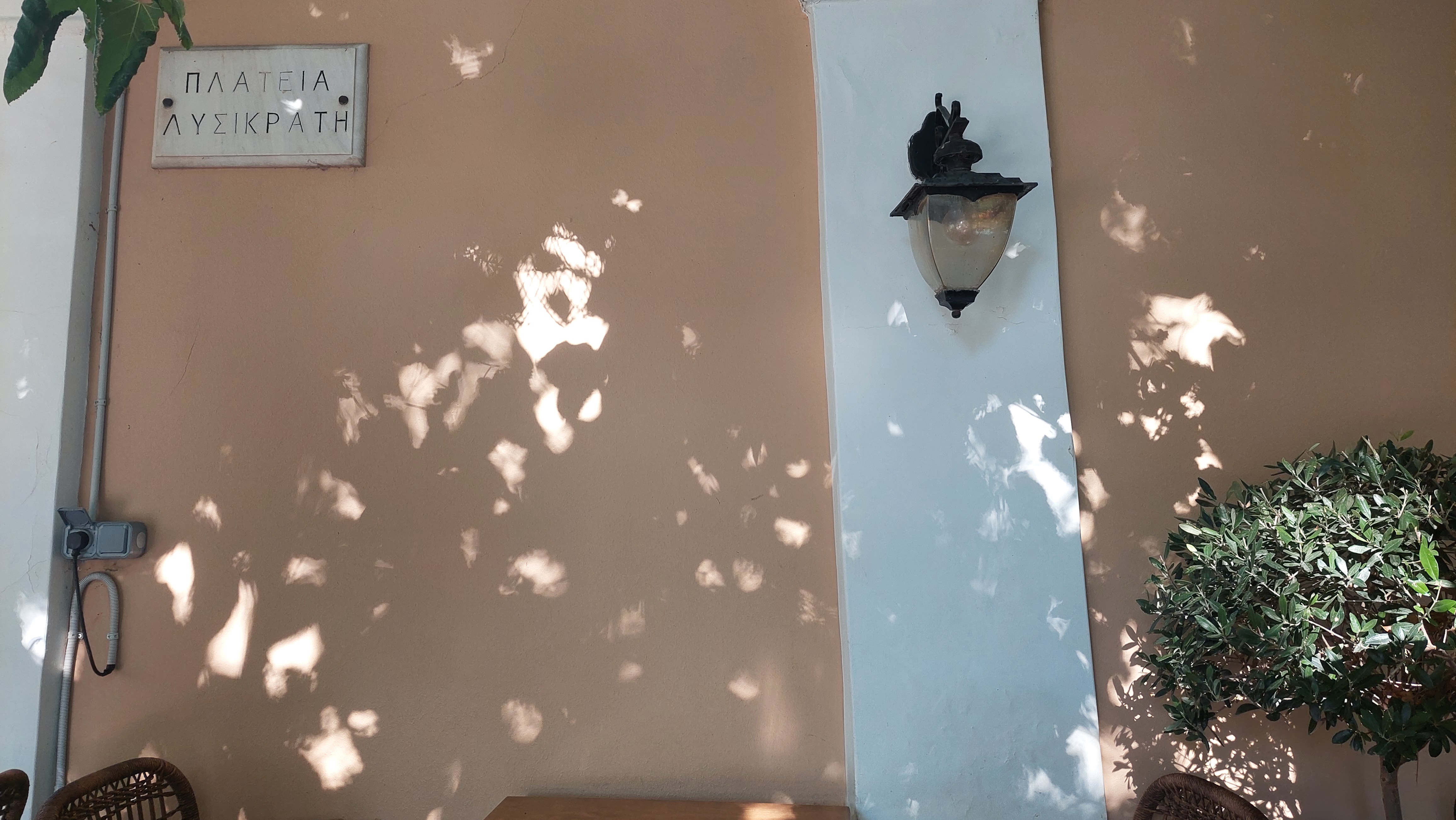
Piața Lisicrate nr. 1.
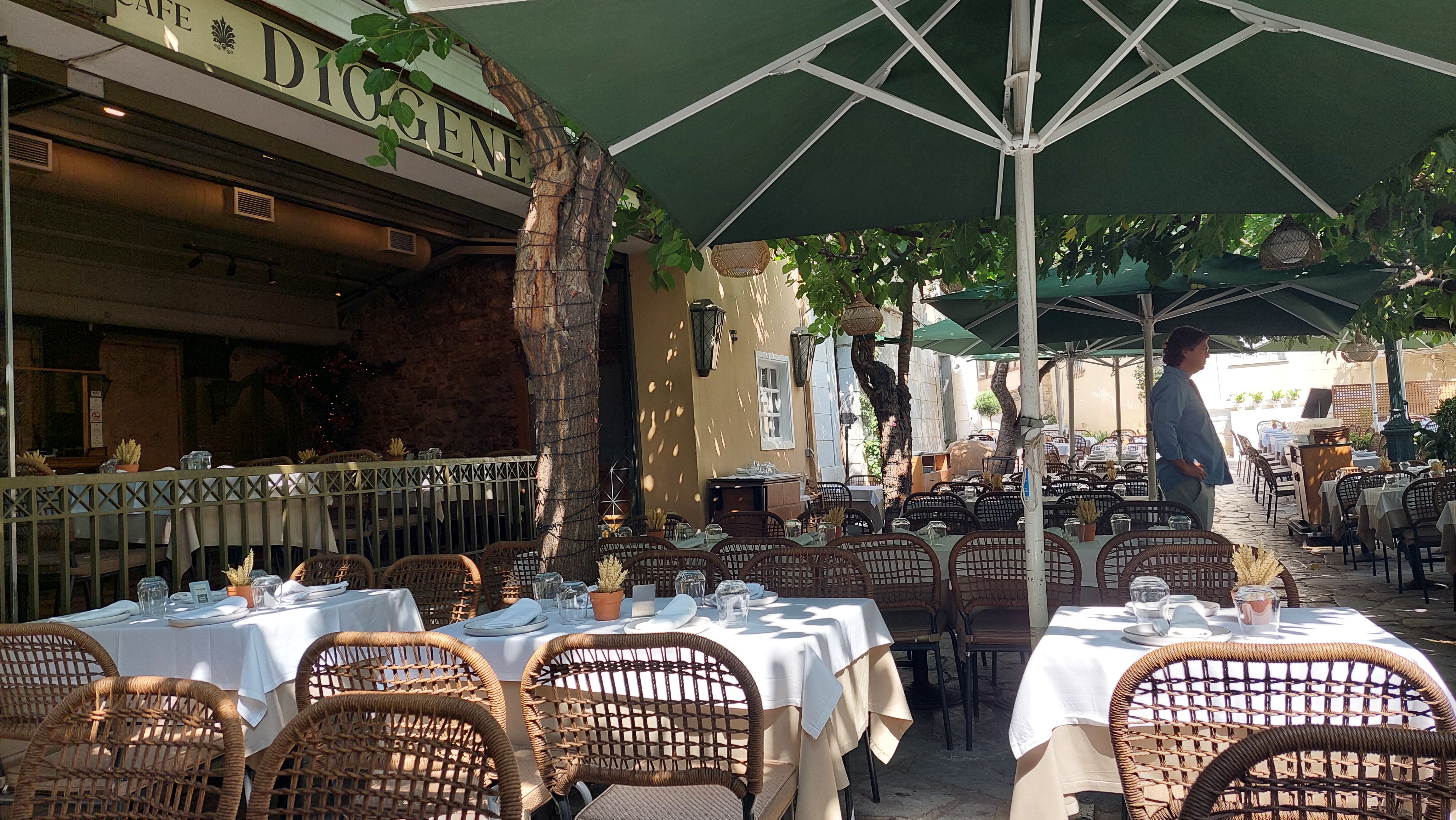
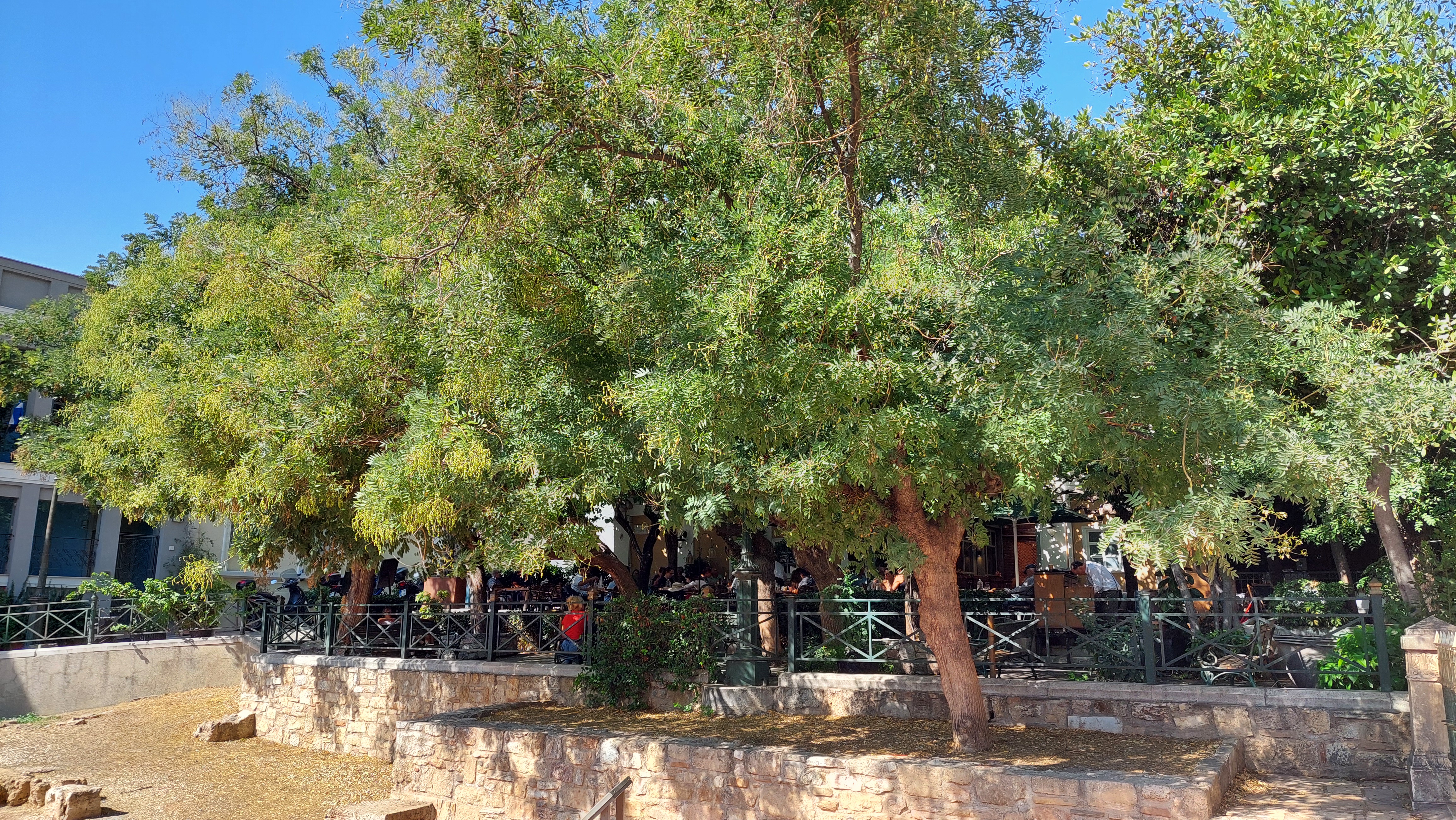
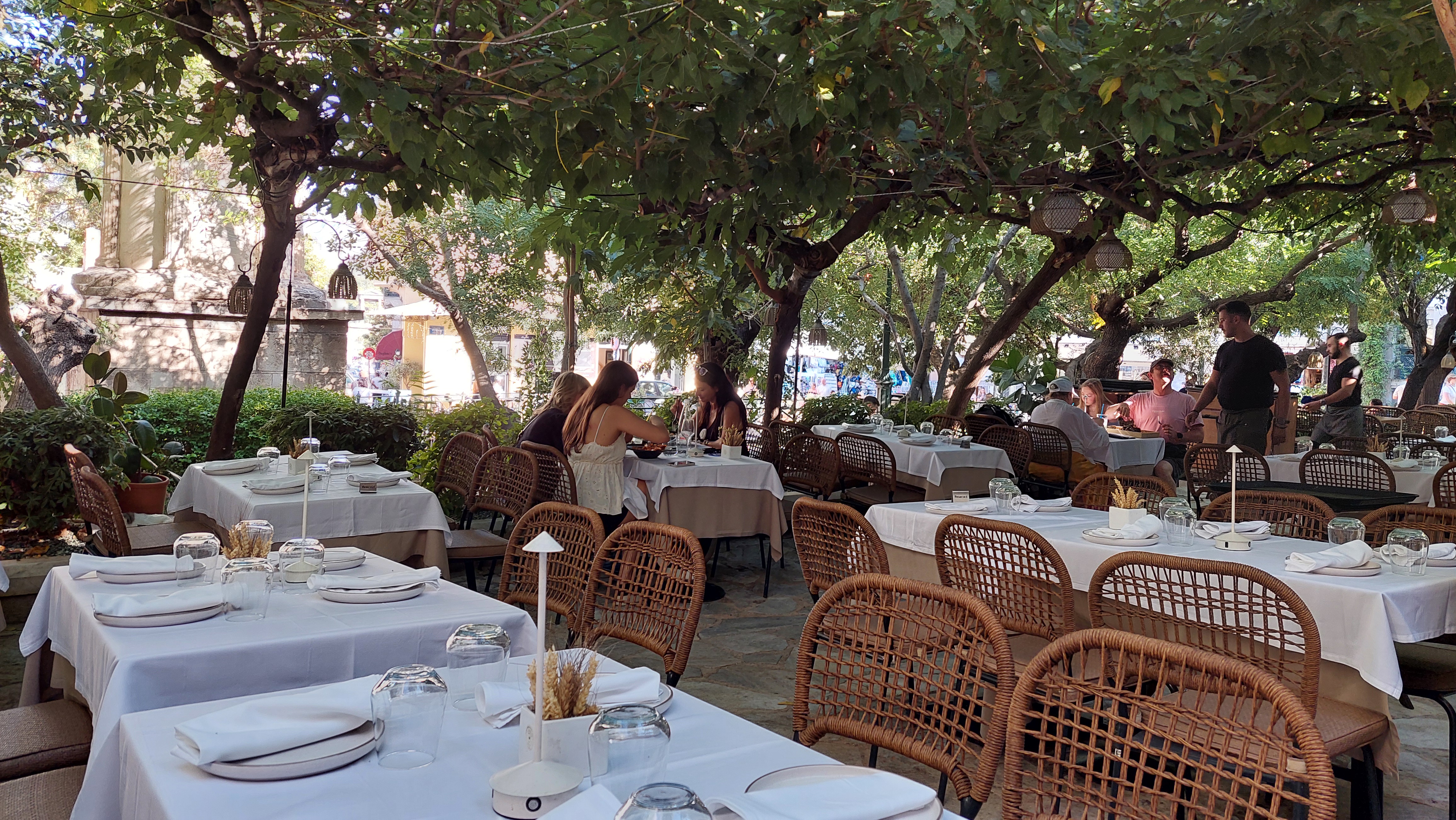
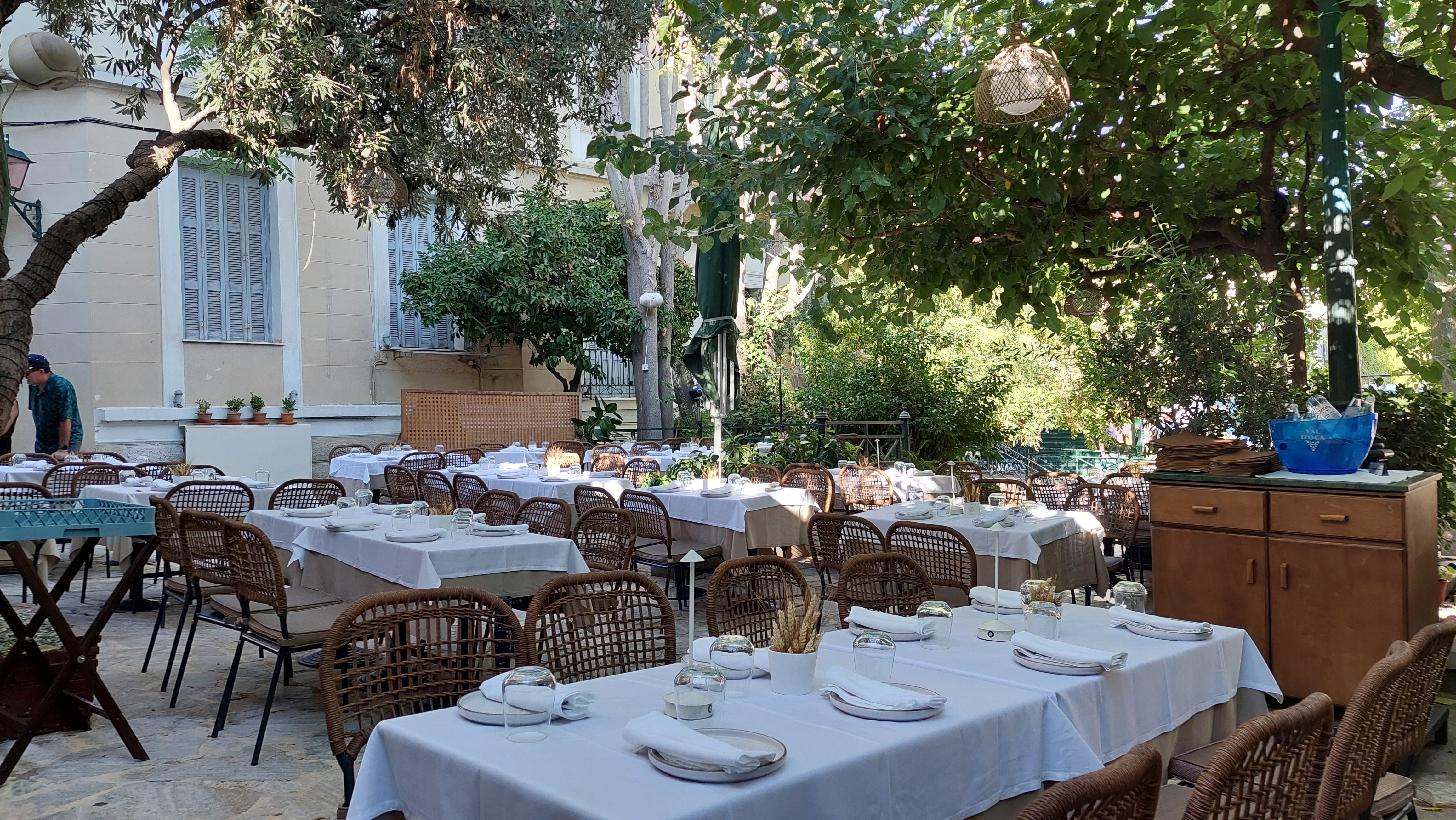
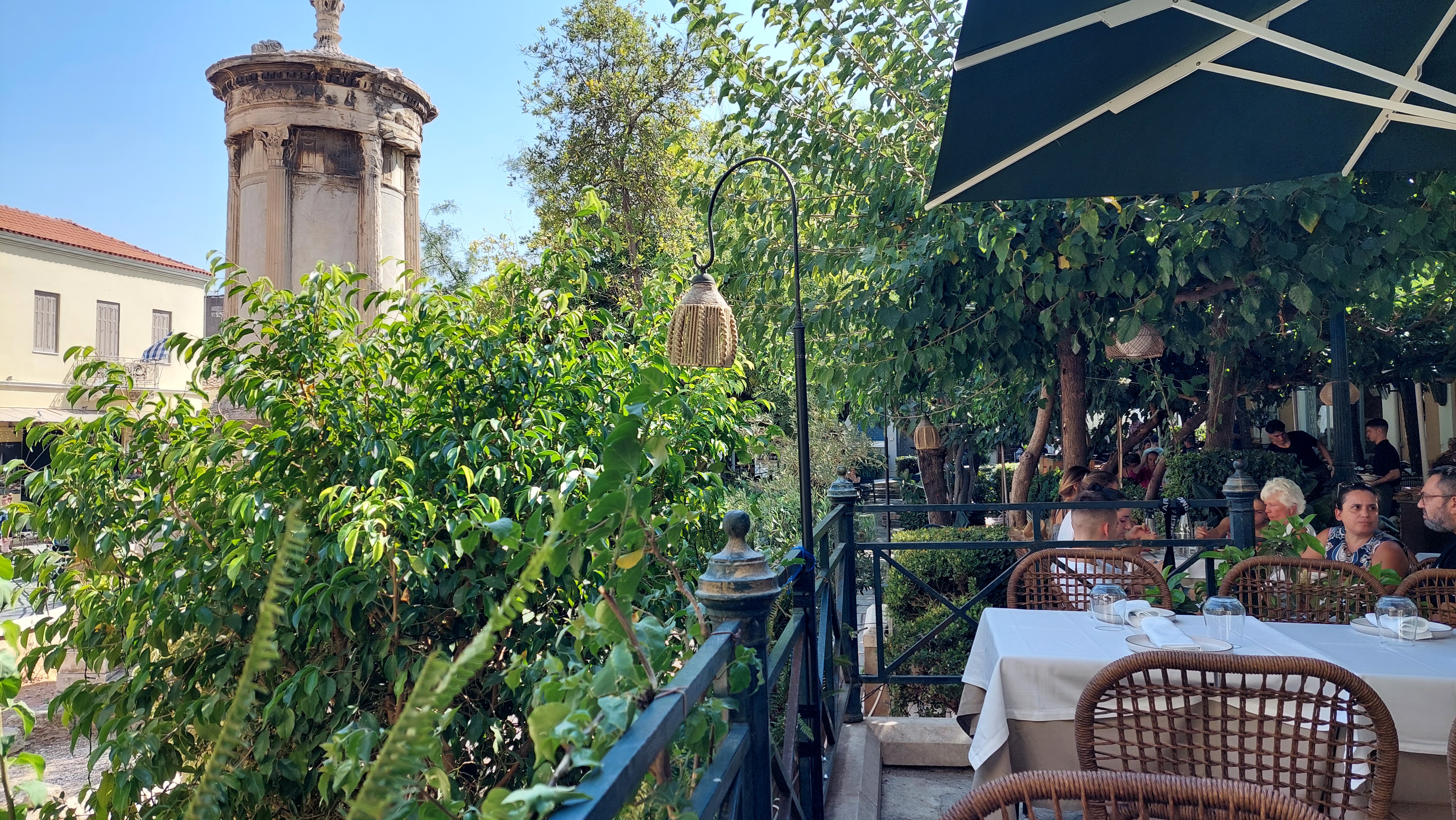
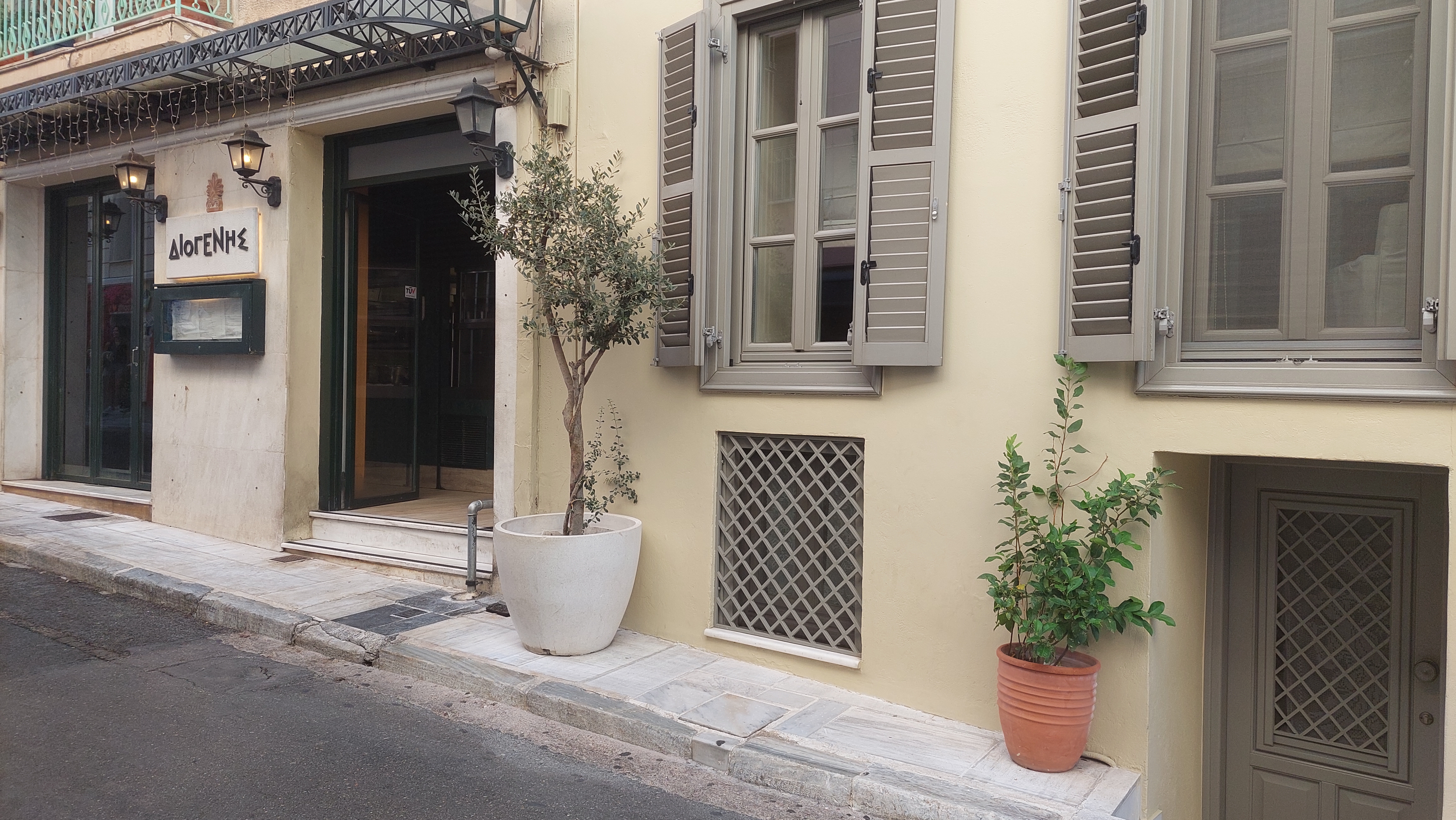
Terasa Diogene.
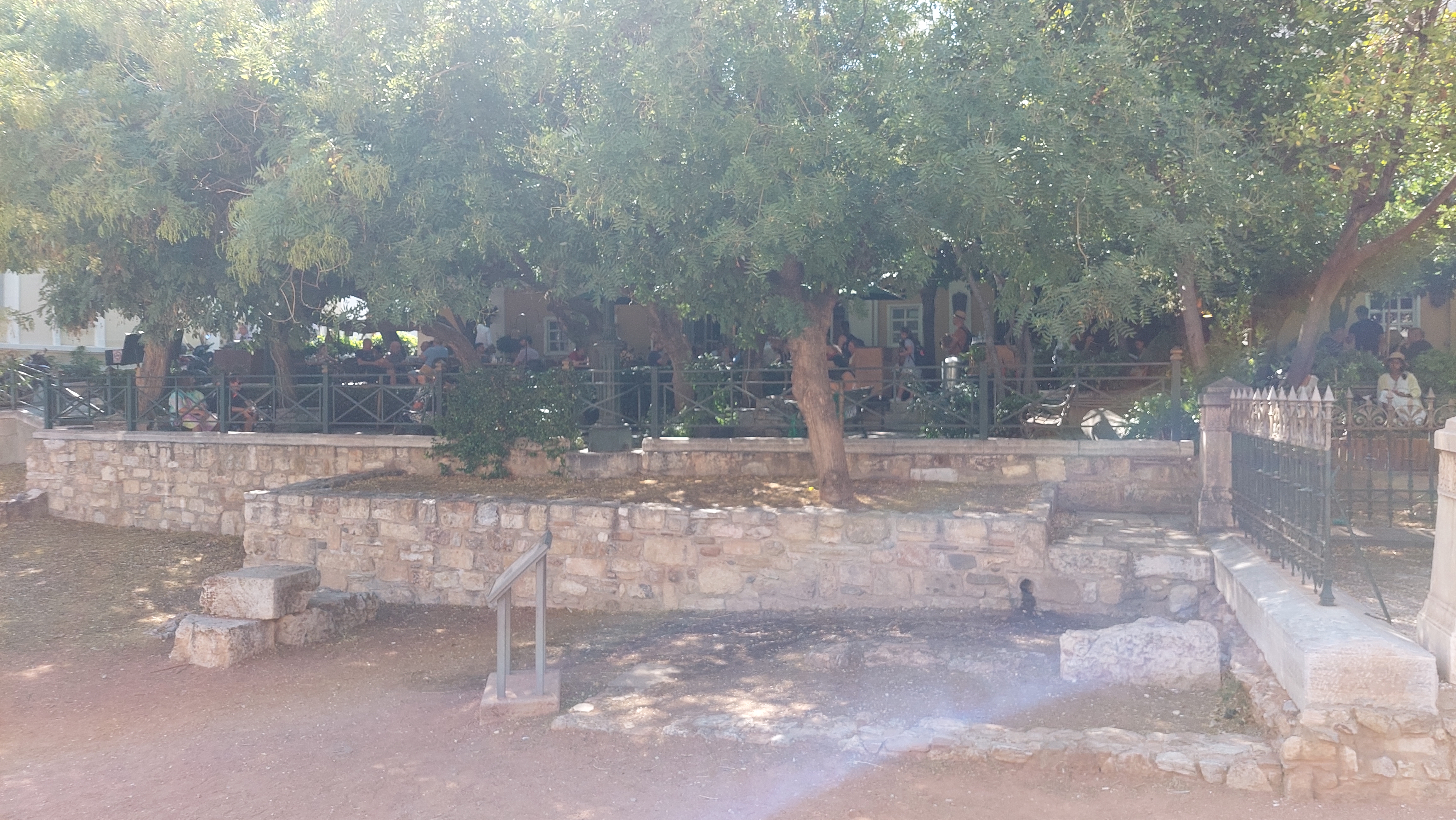
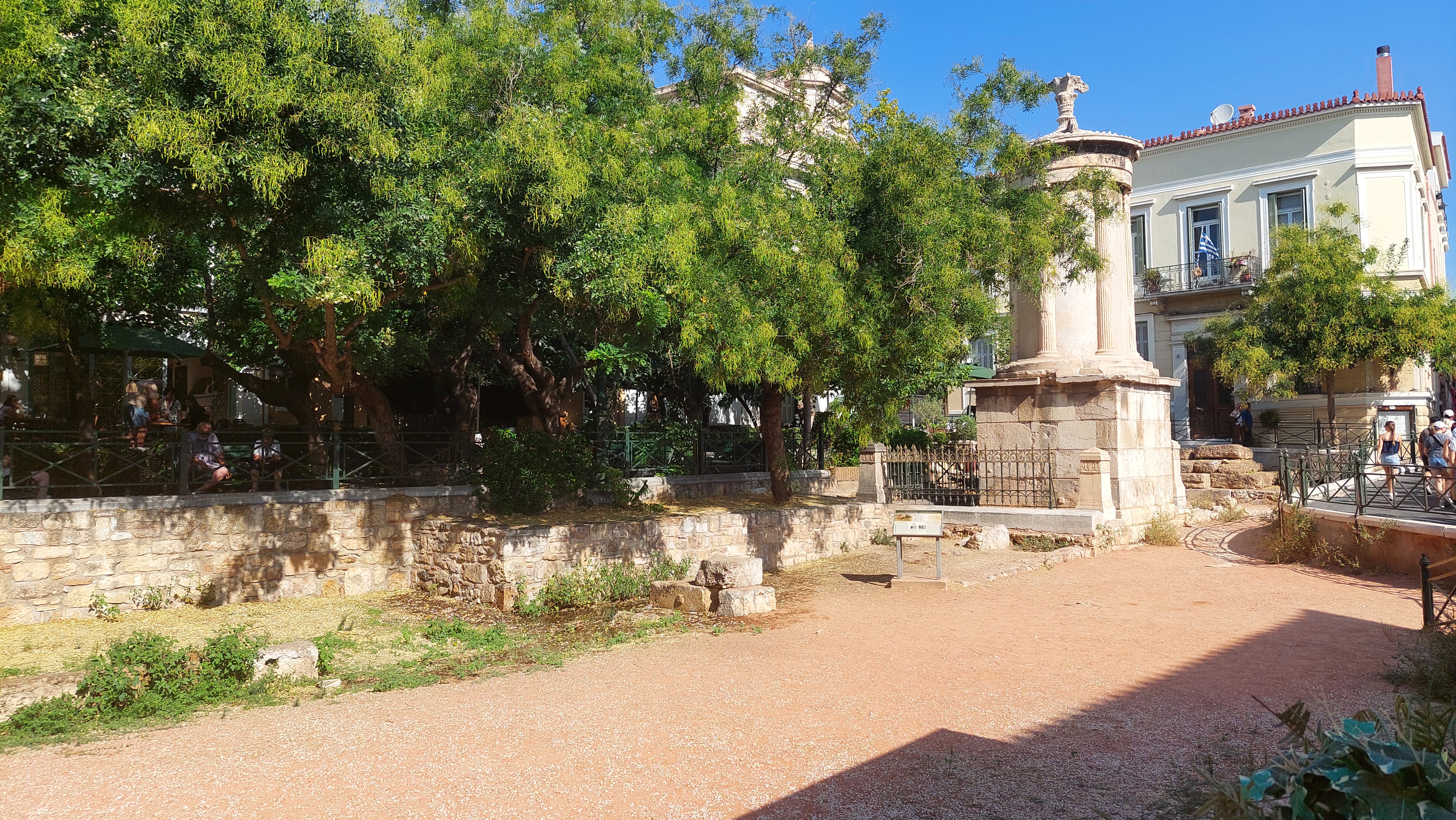
Chiar în fața Monumentului lui Lisicrate, un mic sit arheologic.
Nu mai știu cum am ajuns acolo. Probabil veneam de la Muzeul Acropolei. Mi-era foame și foarte sete.
Am trecut pe lângă terasă și am văzut că era plină de turiști… eleganți, arătând grozav, și mi-am zis: aici sigur gătesc bine…
Între timp, m-am convins că la Diogene se mănâncă cel mai bine.
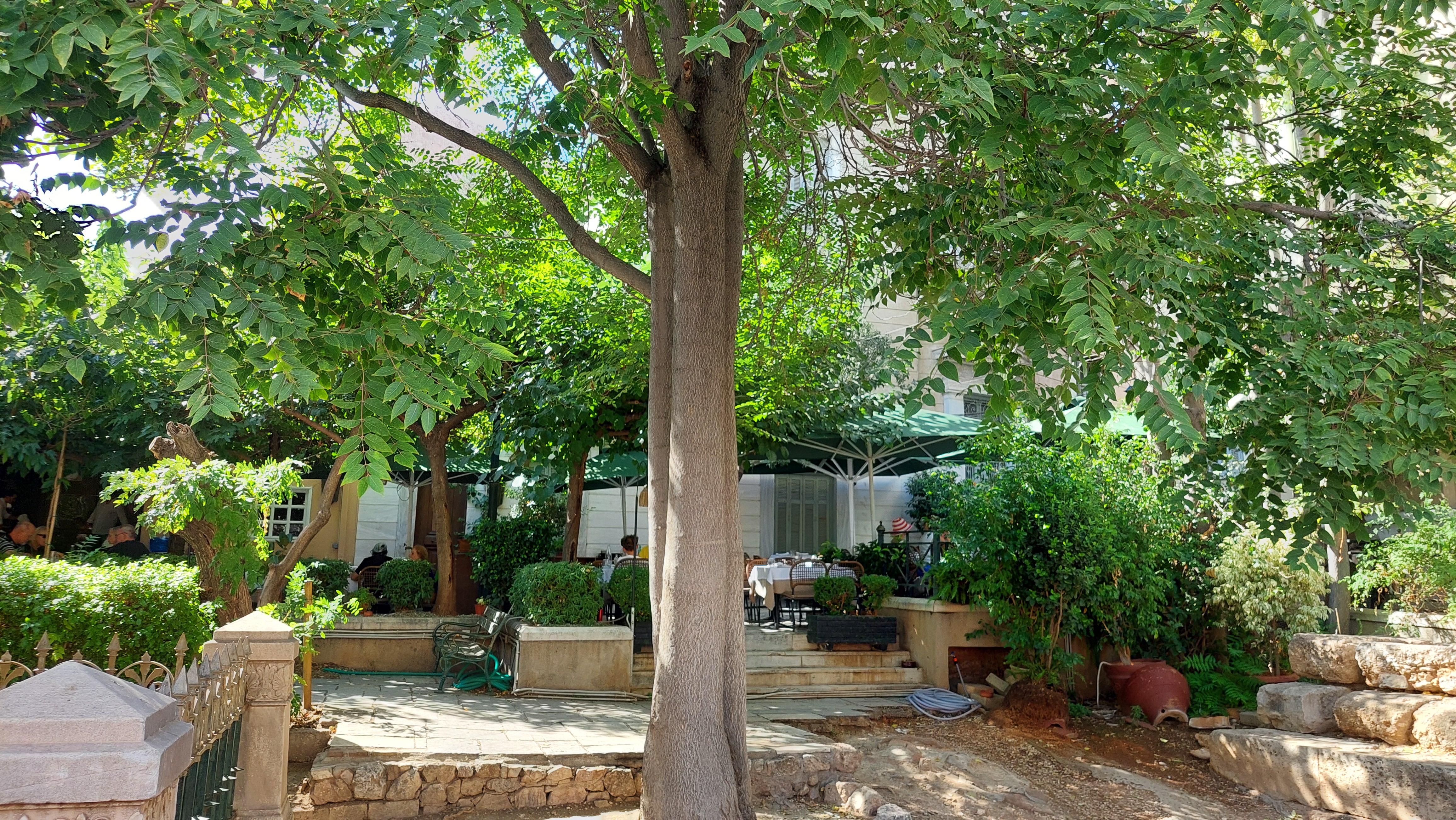
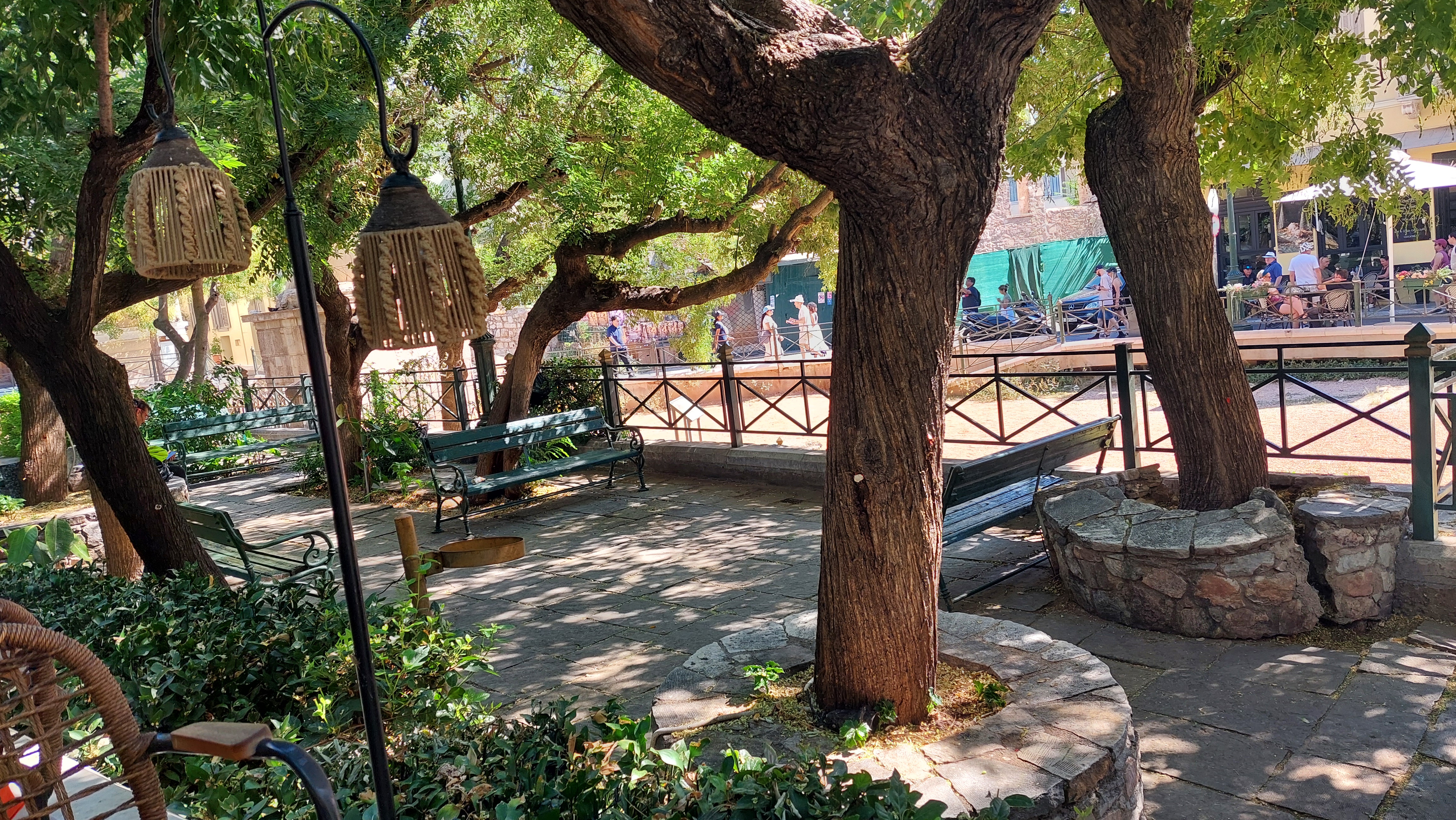
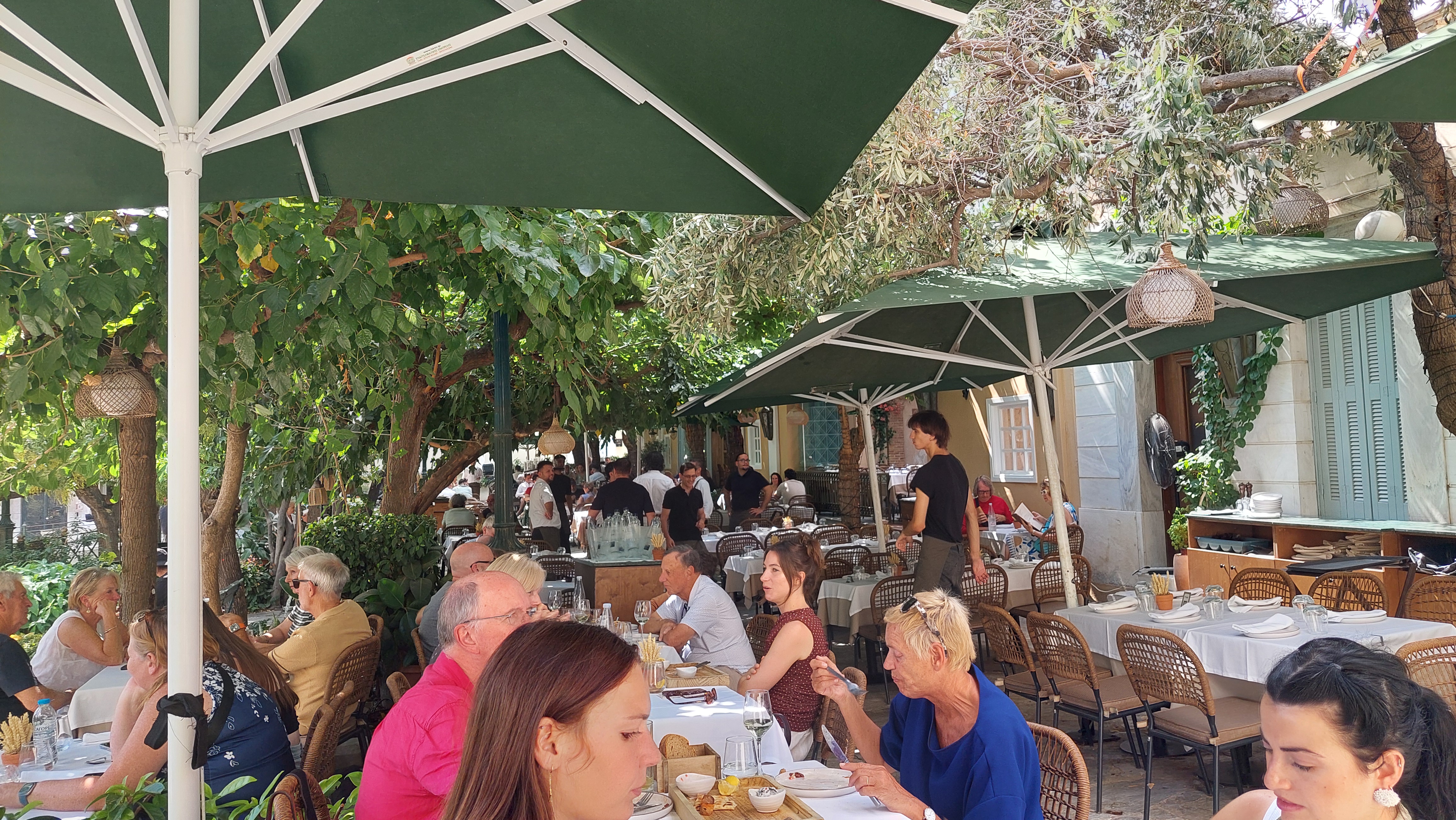
Copaci cu coroane mari, umbroși. Răcoare. O mică Grădină a Edenului. Lumina filtrată de frunze îl face să pară o acuarelă vie.
M-am oprit. I-am privit ușor neîncrezătoare și am urcat micul pasaj pavat cu dale de piatră veche, cine mai știe din ce secol, spre terasă. Eram ușor speriată. Fragilă. Evident, dădusem peste un loc vrăjit.
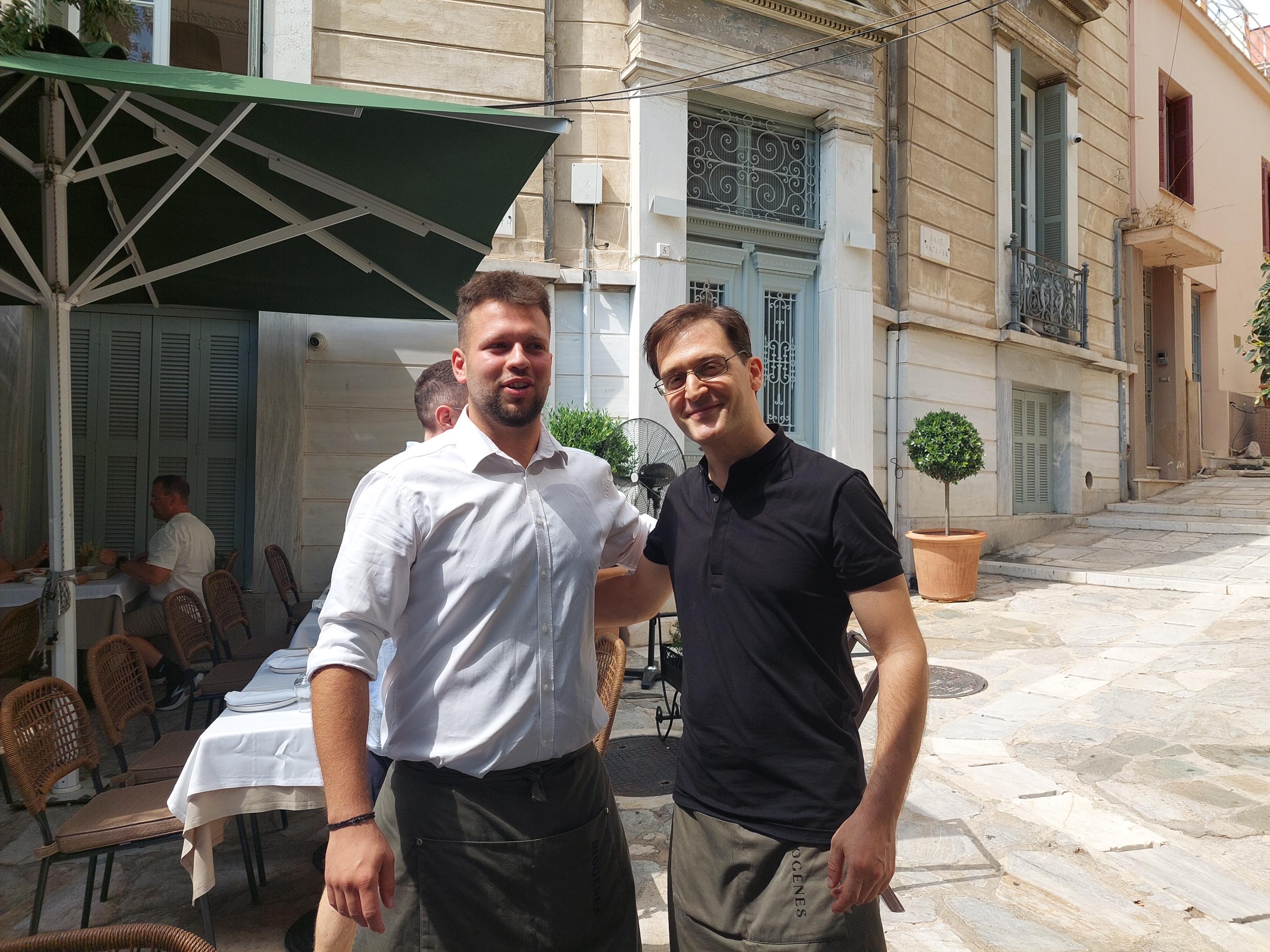
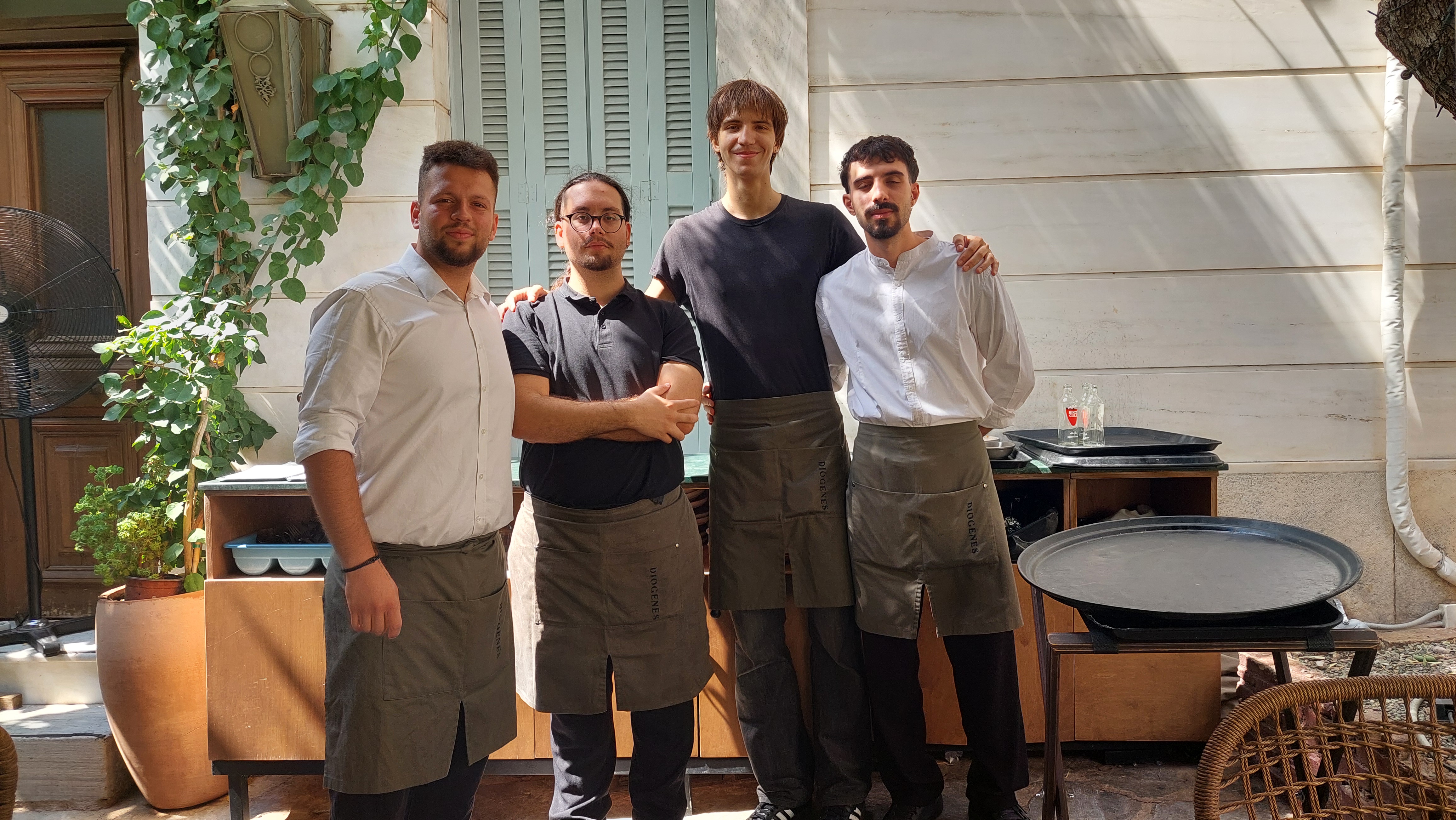
S-au apropiat un ospătar în cămașă albă, impecabilă, cu un șorț de pânză groasă, maro, cu buzunare largi, și un domn despre care aveam să aflu că treaba lui este să se asigure că lumea se simte bine la Diogene. Era Kostas. Iar ospătarul? Nikos.
M-au făcut să simt că ajunsesem… acasă. Priviri calde, afectuoase care spuneau, fără cuvinte: te-am așteptat, de când te așteptam. În sfârșit, ai venit. Ești acasă.
Asta se întâmpla anul trecut, în septembrie. Ne-am împrietenit. Anul ăsta, din nou septembrie, din nou Diogene. Chemarea, vraja locului.
Am închiriat un apartament chiar vizavi de terasă. Shelley nr. 5. Două săptămâni de terapie și de vindecare. Nikos. Ospătarul cel mai modest din lume, cel mai devotat din lume. Un devot. Un terapeut. Voce caldă, tandră, învăluitoare. Ar fi putut fi profesor. Are un dar natural de a vorbi simplu și de a se face înțeles chiar și din inflexiunile vocii. Copiii l-ar fi adorat. A ales să servească la Diogene. Prezența lui repară și vindecă.
Să fie spiritul locului? Localul (restaurant și cafenea de o eleganță perfectă, austeră) a apărut acum 30 de ani. Dar locul unde se află are o istorie care poate explica de ce oamenii lui Diogene sunt speciali.
De ce, aici, cafeaua grecească este cea mai bună din lume.
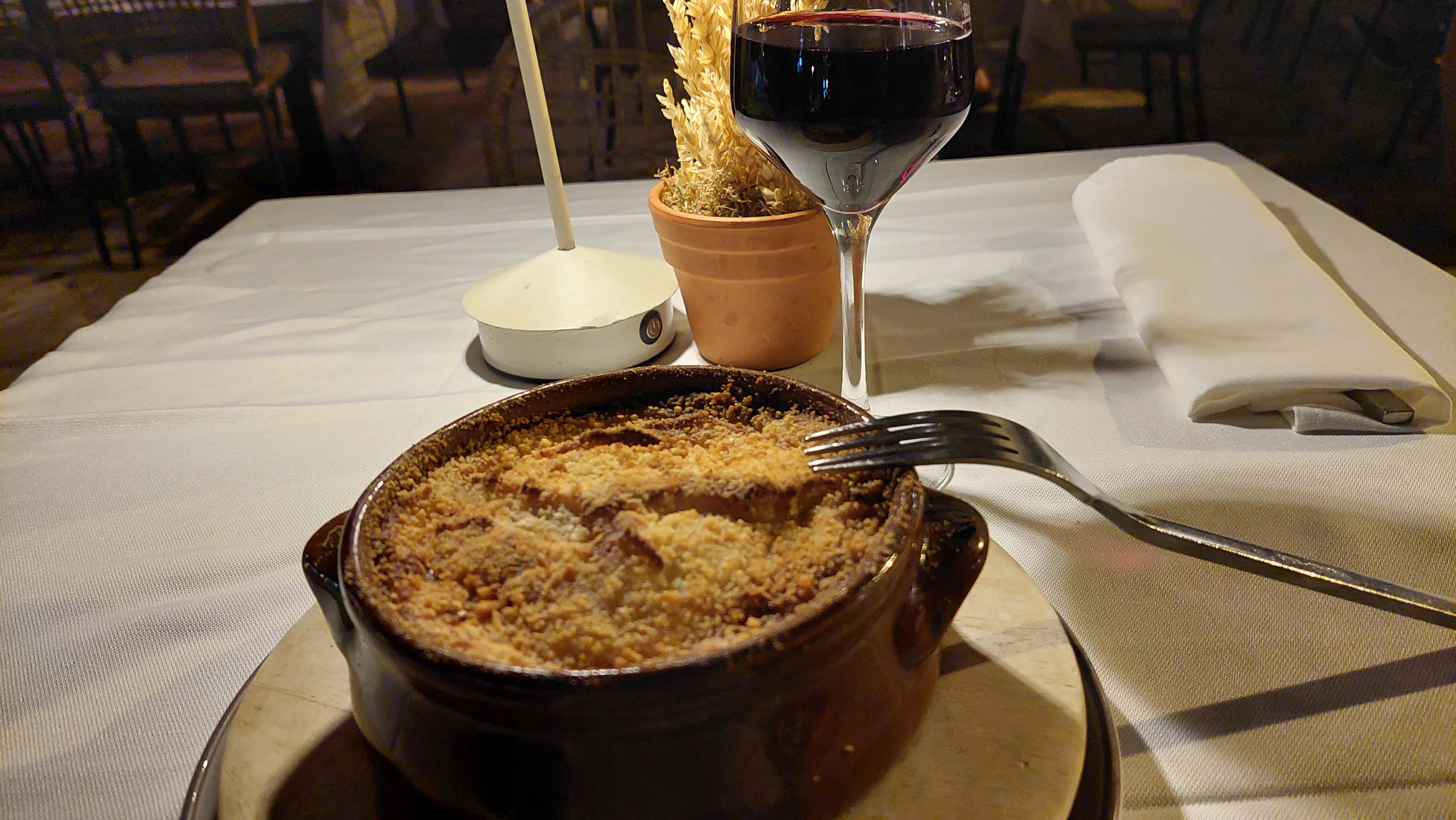
De ce vinurile sunt aristocratice, fine și-ți îmbată până la extaz spiritul, nu mintea, iar mâncarea pare venită din cuhniile mănăstirești și boierești.
De ce Nikos pare să fie întruchiparea diaconilor care serveau la mese la agapele primilor creștini.
De ce, la Diogene, ospitalitatea pare un act de iubire.
Domnul Kostas…
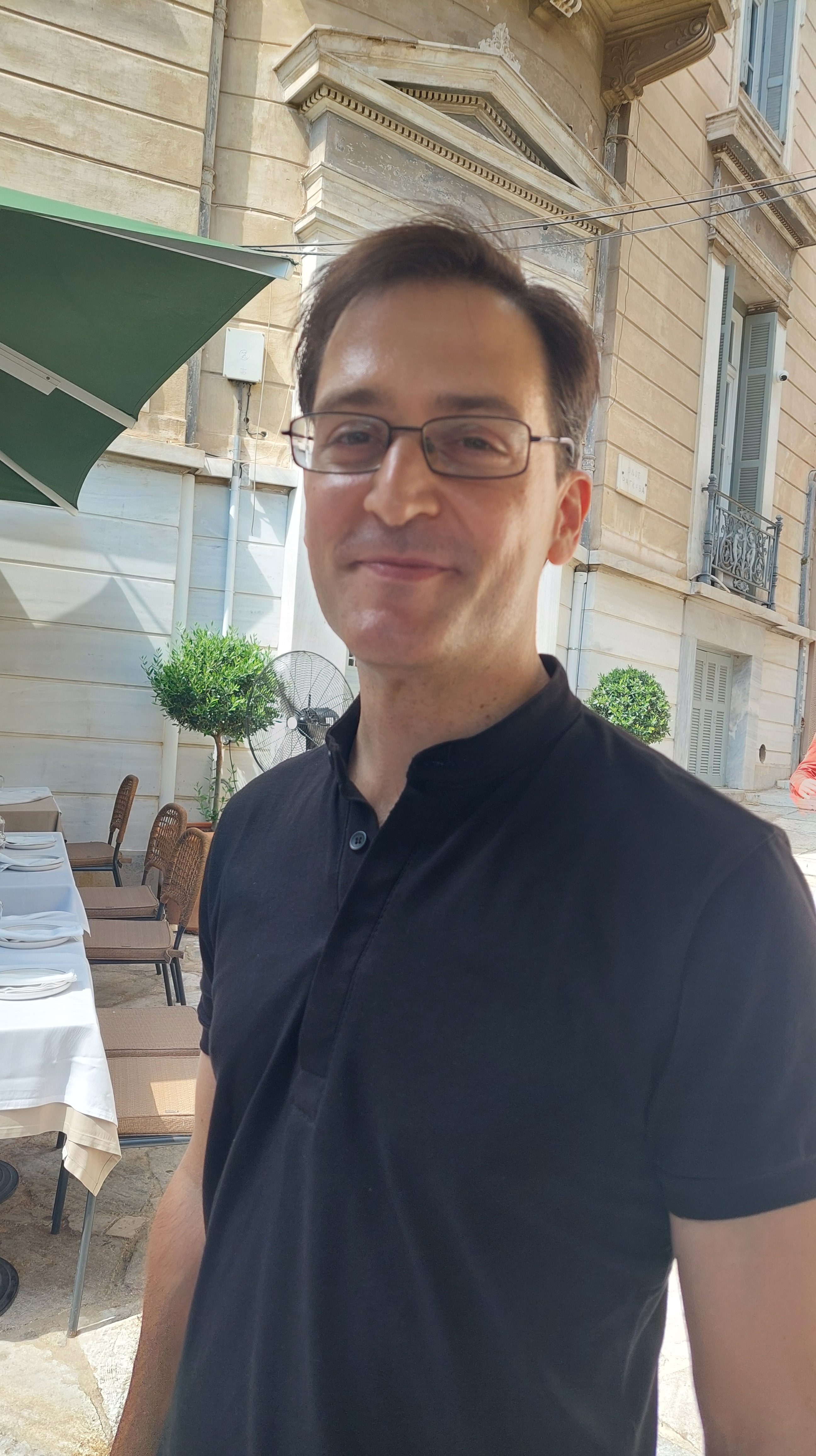
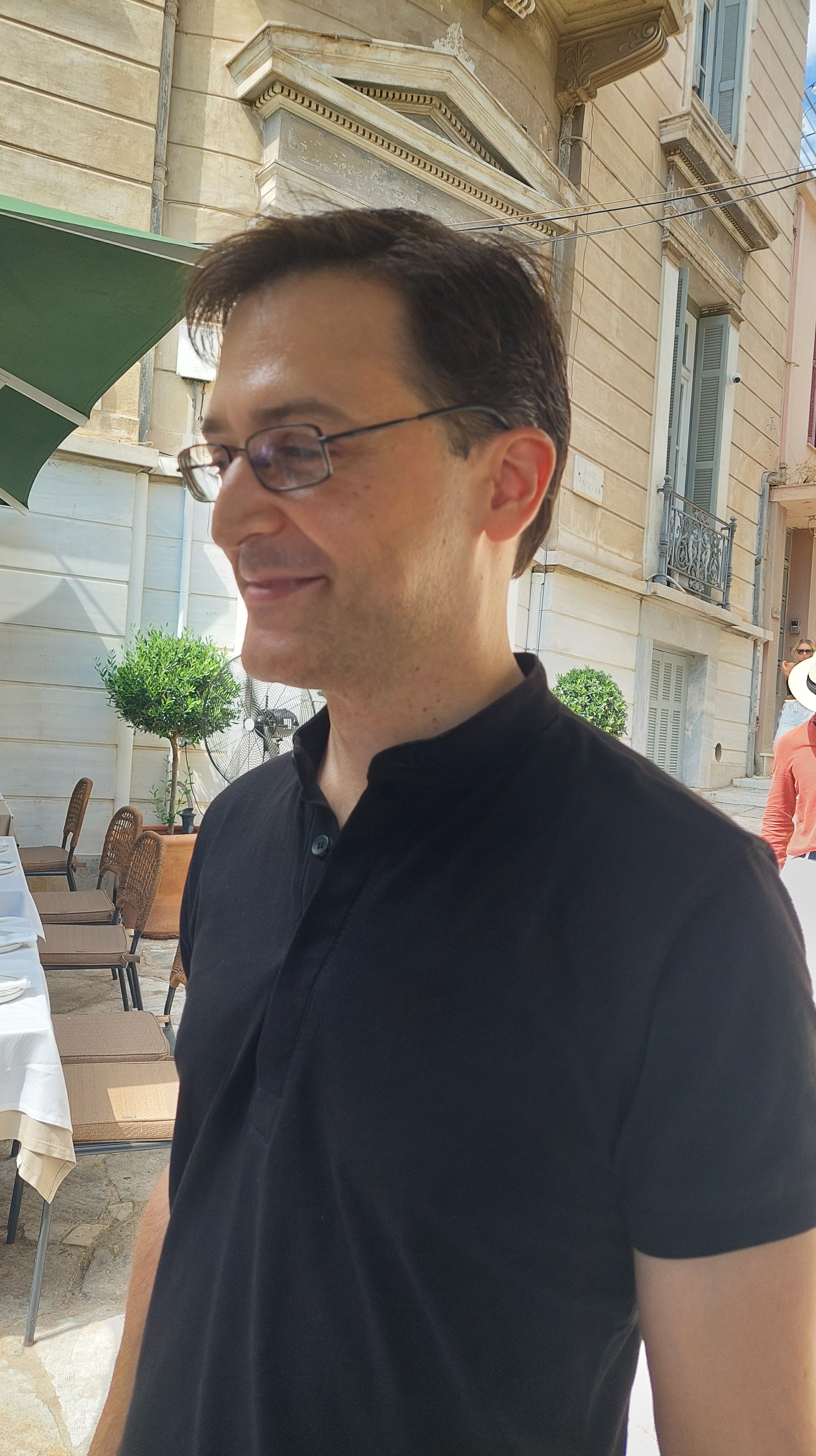
Nikos, două fotografii aproape furate…
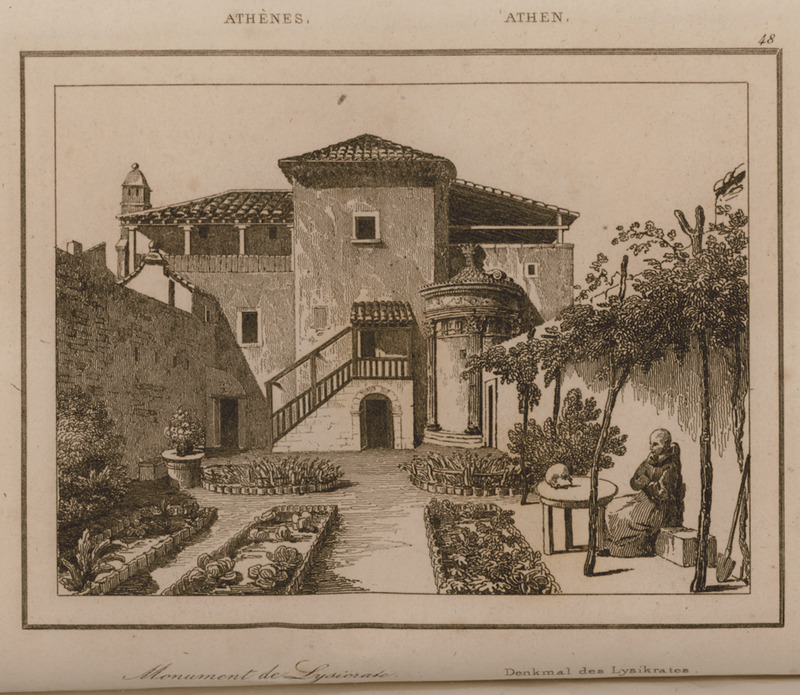
Mănăstirea capucinilor franciscani.
Am început să caut și am aflat că a existat în Piața Lisicrate de azi o mănăstire a iezuiților francezi care, înainte de a părăsi Atena, în 1658, ca să se stabilească în Halkida, capitala Eubeii, au lăsat-o fraților lor capucini.
Am mai aflat că, unsprezece ani mai târziu, starețul mănăstirii, Simion, a cumpărat terenul vecin pe care se afla și se mai află și azi Monumentul lui Lisicrate, pe care l-a… încorporat și l-a transformat în paraclis și, mai târziu, în bibliotecă.
Cât despre mănăstire, călătorii și pelerinii pe care i-a găzduit povesteau că monahii francezi aveau cea mai frumoasă grădină din Atena, răcoroasă și plină de plante și fructe exotice. Un mic paradis.
Poate de aceea și Diogene este astăzi o terasă plină de verdeață din care nu te mai înduri să pleci.
Și mai e și sosul de roșii! Da, merele de aur (pomi d’oro) din Lumea Nouă!
Părintele superior, Francisc (Φραγκίσκος) a rămas în istorie ca unul care a plantat, pentru prima dată în Atena, în minunata grădină a capucinilor, roșii. Era în 1818.
La început erau doar frumoase plante exotice. Apoi bune pentru dulceață și doar mai târziu bune pentru sosul de roșii.
Și încă ceva. Mănăstirea i-a găzduit, printre alți vizitatori iluștri, pe Chateaubriand și pe Lord Byron (1810-1811) care aici a scris The Curse of Minerva (Athens: Capuchin Convent, March 17, 1811).
Din păcate, mănăstirea a ars din temelii la Revoluția din 1821 (sau, după alte surse în timpul Asediului Acropolei, 1826–1827).
Dar, din fericire, Monumentul lui Lisicrate a scăpat ca prin minune, ca să ajungă ceva mai târziu… fânar.
Se pare, totuși, că spiritul lui Hristos a rămas să vegheze și să binecuvânteze micul său Rai din piața Lisicrate, Diogene, restaurantul emblematic din cartierul de la poalele Acropolei unde, cum spuneam, ospitalitatea a devenit un act de iubire.
Monumentul lui Lisicrate.
Am vorbit despre mănăstire pentru că, pentru mine, duhurile călugărilor francezi se mai poartă și azi peste mesele de la Diogene. Poate chiar se așează la masă cu noi și sunt ghizii oamenilor care ne servesc.
Dar Diogene se află, deloc întâmplător, în piața Lisicrate. Piață care și-a luat numele de la unul din choregii atenieni, pe numele lui Lisicrate. Astăzi l-am numi sponsor.
Acest Lisicrate a câștigat un trepied de bronz. Un fel de Oscar. De ce? A sponsorizat corul de băieți care a luat locul I la concursul de ditiramb la Dionisiile urbane din 335-334 î. Hr. (așa cum scrie pe inscripția dedicatorie gravată pe arhitravă).
Și, cum era obiceiul, i-a făcut un monument, ca o coloană, în vârful căruia l-a așezat. Din păcate, trepiedul s-a pierdut. Dar monumentul există și astăzi.
Pe strada care, pe vremea lui Lisicrate, se numea… a Trepiedelor (Odos Tripodon/Oδός Τριπόδων). Cea mai veche stradă din Europa, cea mai populară din vechea Atenă, din cel mai vechi cartier din Europa, Plaka.
De ce strada Trepiedelor? Pentru că, așa cum ne arată bazele rămase de la alte patru asemenea monumente ale învingătorilor la concursurile de tragedie, era o stradă a Trepiedelor. A Oscarurilor de atunci.
O stradă care arăta probabil ca o stoa, lungă de aproape 800 de metri, care începea de la Pritaneul din Agora (Pausanias, Descrierea Greciei 1,20,1) și se termina la teatrul lui Dionisos.
O promenadă cu monumente ale choregilor de-o parte și de alta. O Hollywood Walk of fame, să zicem. Sau, mai degrabă, Aleea Celebrităților din vechea Atenă.
Cu timpul, Monumentul lui Lisicrate devine „Lampa lui Demostene” (așa apare pentru prima dată într-un manuscris al unui călător grec de la 1460, numit „Anonimul din Viena,” descoperit în Biblioteca din Viena), iar „Lampa lui Demostene” devine în secolul XIX „Lampa lui Diogene” (το Φανάρι του Διογένη).
Și nu m-ar mira, aflându-vă la Diogene, să zăriți plimbându-se zâmbitoare și atotfericite, printre mese, umbrele choregilor atenieni.
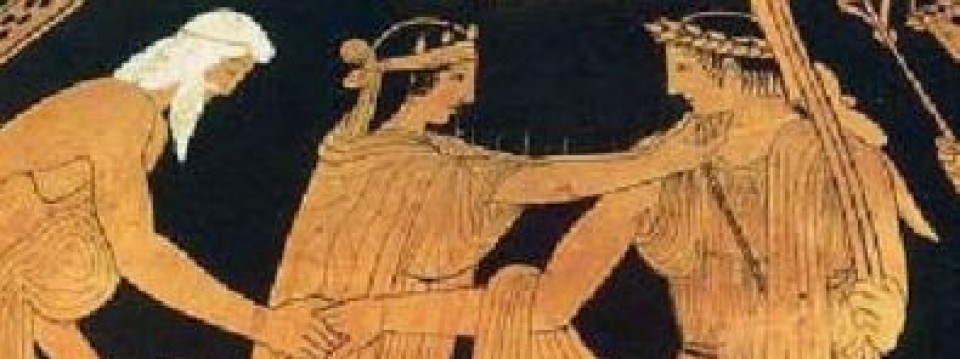
Răpirea lui Dionisos.
Cum e și firesc, monumentele acestor choregi erau dedicate zeului Dionisos, în cinstea căruia se țineau concursurile de tragedie/teatru, la sărbătorile lui, Dionisiile din Atena.
Iar Lisicrate a pus ca pe friza monumentului său să fie reprezentată istoria răpirii zeului, în propria sa variantă a mitului. Mit care spune că niște pirați tirenieni au văzut, probabil într-o dimineață de vară, pe o plajă, un tânăr de o frumusețe nemaivăzută și l-au răpit, crezând că era vreun prinț pentru care aveau să ceară o recompensă grozavă.
Numai că, tânărul era chiar Dionisos. Timonierul i-a prevenit și a încercat să-i oprească. Degeaba. Pedeapsa? Zeul a făcut ca din catargul corăbiei să răsară viță de vie și iederă, corabia să se umple de vin (Homer, Imnul 7 către Dionisos) (și muzici dionisiace să răsune în văzduh – cel puțin așa îmi închipui eu), iar el însuși să urmărească scena, așezat, cu o panteră alături, în timp ce satirii săi îi prefac pe pirați în delfini (varianta lui Lisicrate).
Poate de aceea, uneori, seara, când pe mese la Diogene se aprind delicatele lămpi, lumea se însuflețește brusc, se aud râsete și parcă se aud și muzici de nicăieri, semn că zeul ospețelor, el însuși trece ușor, nevăzut, printre meseni.
Diogene… Pentru mine nu-i o simplă terasă… ci un loc unde mănânci și bei, fără să știi, poate cu umbrele oamenilor de teatru din vechea Atenă, ale capucinilor francezi, cu umbra lui Byron sau iei parte la un ospăț dionisiac.
Și încă ceva: scările care te duc la Anafiotika, micul cartier al meșterilor zidari din Anafi, încep de la terasa cafenelei Diogene.
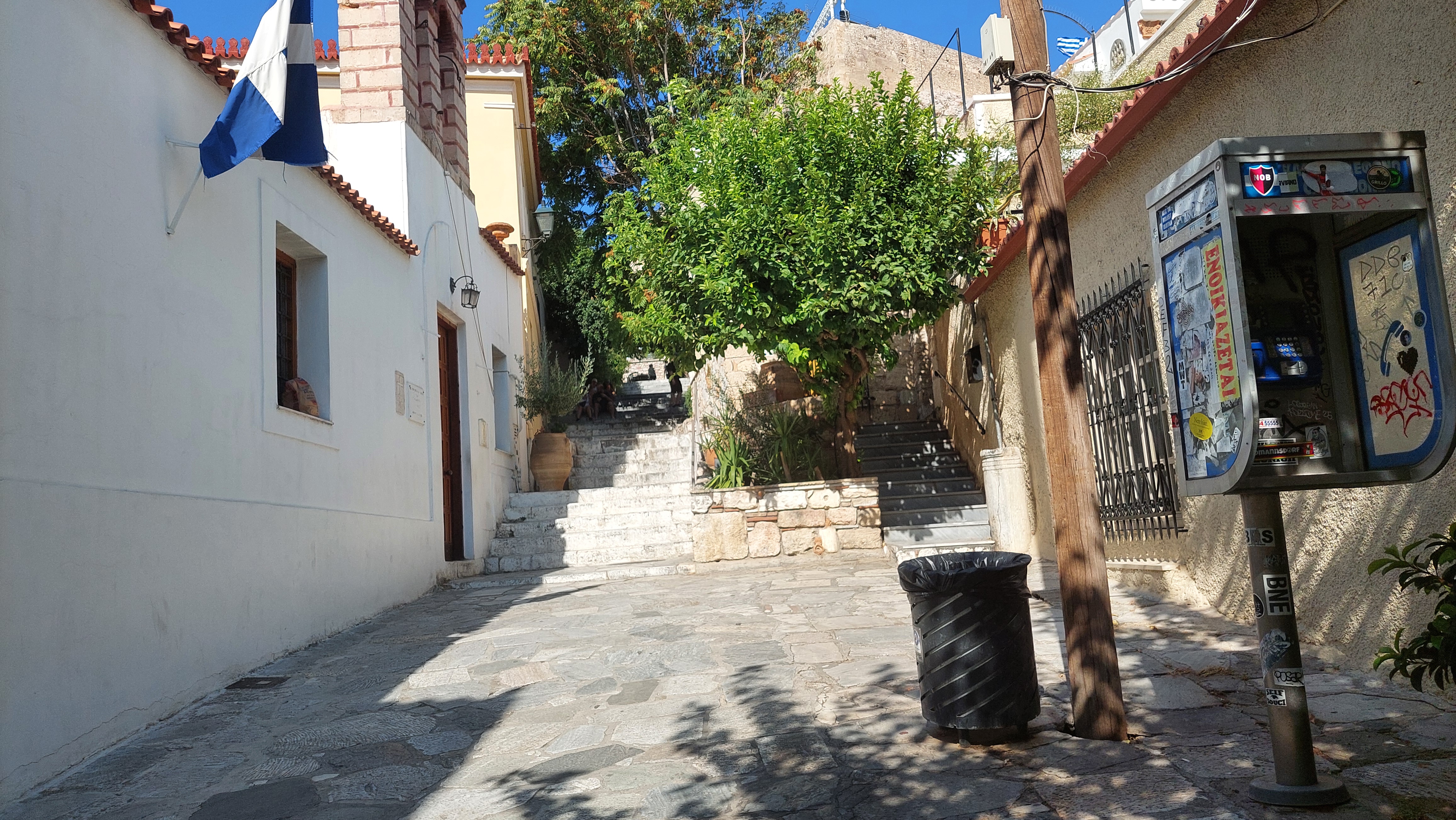
Scara care duce de la Diogene spre… Anafiotika
Urmează continuarea…
ΠΛΑΚΑ (Ι) – ΠΛΑΤΕΙΑ ΛΥΣΙΚΡΑΤΟΥΣ. Ο ΔΙΟΓΕΝΗΣ ΚΑΙ Ο ΑΦΟΣΙΩΜΕΝΟΣ ΣΕΡΒΙΤΟΡΟΣ ΤΟΥ
Ο Διογένης και ο Νίκος
Πλάκα. Η παλαιότερη συνοικία της Αθήνας. Και της Ευρώπης. Η Παλιά Πόλη στους πρόποδες της Ακρόπολης, του ιερού βράχου της Αθήνας, όπου διακρίνεται ακόμη και σήμερα το Θέατρο του Διονύσου. Κοντά στην Αγορά του Σωκράτη.
Μια συνοικία με αρχοντικά νεοκλασικού ρυθμού, χτισμένα στα τέλη του 19ου και στις αρχές του 20ού αιώνα, με γραφικές ταβέρνες και υπαίθρια καθιστικά απλωμένα πάνω σε μακριές πέτρινες σκάλες, πάντα γεμάτα από εκλεκτό κόσμο.
Πλατεία Λυσικράτους 1.
Η ταράτσα του Διογένη.
Ακριβώς απέναντι από το Μνημείο του Λυσικράτη, έναν μικρό αρχαιολογικό χώρο.
Δεν θυμάμαι πια πώς βρέθηκα εκεί. Μάλλον ερχόμουν από το Μουσείο της Ακρόπολης. Πεινούσα και διψούσα πολύ.
Περνώντας μπροστά από την ταράτσα, είδα πως ήταν γεμάτη τουρίστες… καλοντυμένους, κομψούς, περιποιημένους, και σκέφτηκα: εδώ σίγουρα θα μαγειρεύουν καλά…
Στο μεταξύ, πείστηκα ότι στον Διογένη τρως καλύτερα απ’ οπουδήποτε αλλού.
Δέντρα με μεγάλες, πυκνές φυλλωσιές. Σκιά. Δροσιά. Ένας μικρός Κήπος της Εδέμ. Το φως, φιλτραρισμένο μέσα από τα φύλλα, κάνει τον χώρο να μοιάζει με ζωντανή υδατογραφία.
Στάθηκα. Τους κοίταξα κάπως δύσπιστα και ανέβηκα το μικρό πέρασμα, στρωμένο με παλιές πέτρινες πλάκες, ποιος ξέρει από ποιον αιώνα, που οδηγούσε στην ταράτσα. Ήμουν λίγο φοβισμένη. Ευάλωτη. Ήταν ολοφάνερο πως είχα πέσει πάνω σ’ έναν μαγεμένο τόπο.
Με πλησίασαν ένας σερβιτόρος με άψογο λευκό πουκάμισο και μια καφετιά ποδιά από χοντρό ύφασμα, με μεγάλες τσέπες, κι ένας κύριος για τον οποίο θα μάθαινα αργότερα πως δουλειά του ήταν να φροντίζει να περνούν όλοι καλά στον Διογένη.
Ήταν ο Κώστας.
Και ο σερβιτόρος;
Ο Νίκος.
Με έκαναν να νιώσω πως είχα φτάσει… στο σπίτι μου.
Ζεστά, γεμάτα στοργή βλέμματα που έλεγαν, χωρίς λόγια: «Σε περιμέναμε, πόσο καιρό σε περιμέναμε! Επιτέλους ήρθες. Είσαι στο σπίτι σου».
Αυτό συνέβη πέρυσι, τον Σεπτέμβριο. Γίναμε φίλοι.
Φέτος, πάλι Σεπτέμβριος, πάλι Διογένης. Το κάλεσμα, η μαγεία του τόπου.
Νοίκιασα ένα διαμέρισμα ακριβώς απέναντι από την ταράτσα. Οδός Σέλλεϋ 5.
Δύο εβδομάδες θεραπείας και ίασης.
Ο Νίκος.
Ο πιο ταπεινός σερβιτόρος του κόσμου, ο πιο αφοσιωμένος του κόσμου.
Ένας άνθρωπος της προσφοράς. Ένας θεραπευτής.
Φωνή ζεστή, τρυφερή, που σε τυλίγει σαν χάδι.
Θα μπορούσε να είναι δάσκαλος. Έχει το φυσικό χάρισμα να μιλά απλά και να γίνεται κατανοητός ακόμη και μέσα από τις αποχρώσεις της φωνής του. Τα παιδιά θα τον λάτρευαν.
Επέλεξε να υπηρετεί στον Διογένη.
Η παρουσία του επουλώνει πληγές και θεραπεύει.
Να είναι άραγε το πνεύμα του τόπου;
Το μαγαζί — εστιατόριο και καφέ απαράμιλλης, λιτής κομψότητας — άνοιξε πριν από τριάντα χρόνια. Όμως ο τόπος όπου βρίσκεται έχει μια ιστορία που ίσως εξηγεί γιατί οι άνθρωποι του Διογένη είναι τόσο ξεχωριστοί.
Γιατί εδώ ο ελληνικός καφές είναι ο καλύτερος στον κόσμο.
Γιατί τα κρασιά είναι αριστοκρατικά, εκλεπτυσμένα, και μεθούν μέχρι έκστασης το πνεύμα σου, όχι το μυαλό σου, ενώ το φαγητό μοιάζει να έρχεται από τις κουζίνες παλιών μοναστηριών και αρχοντικών.
Γιατί ο Νίκος μοιάζει να είναι η ενσάρκωση των διακόνων που υπηρετούσαν στα τραπέζια, στις αγάπες των πρώτων χριστιανών.
Γιατί στον Διογένη η φιλοξενία μοιάζει με πράξη αγάπης.
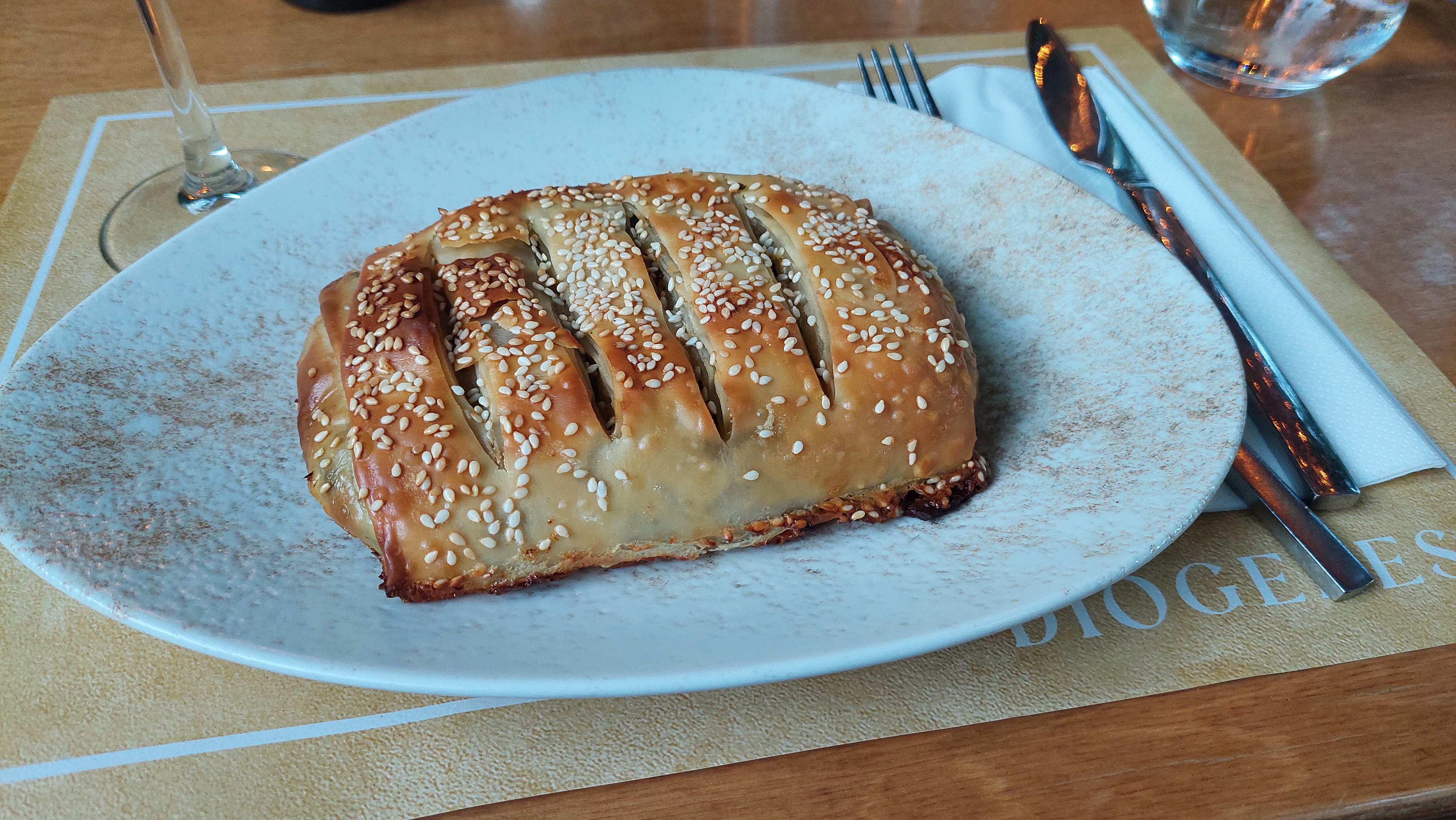
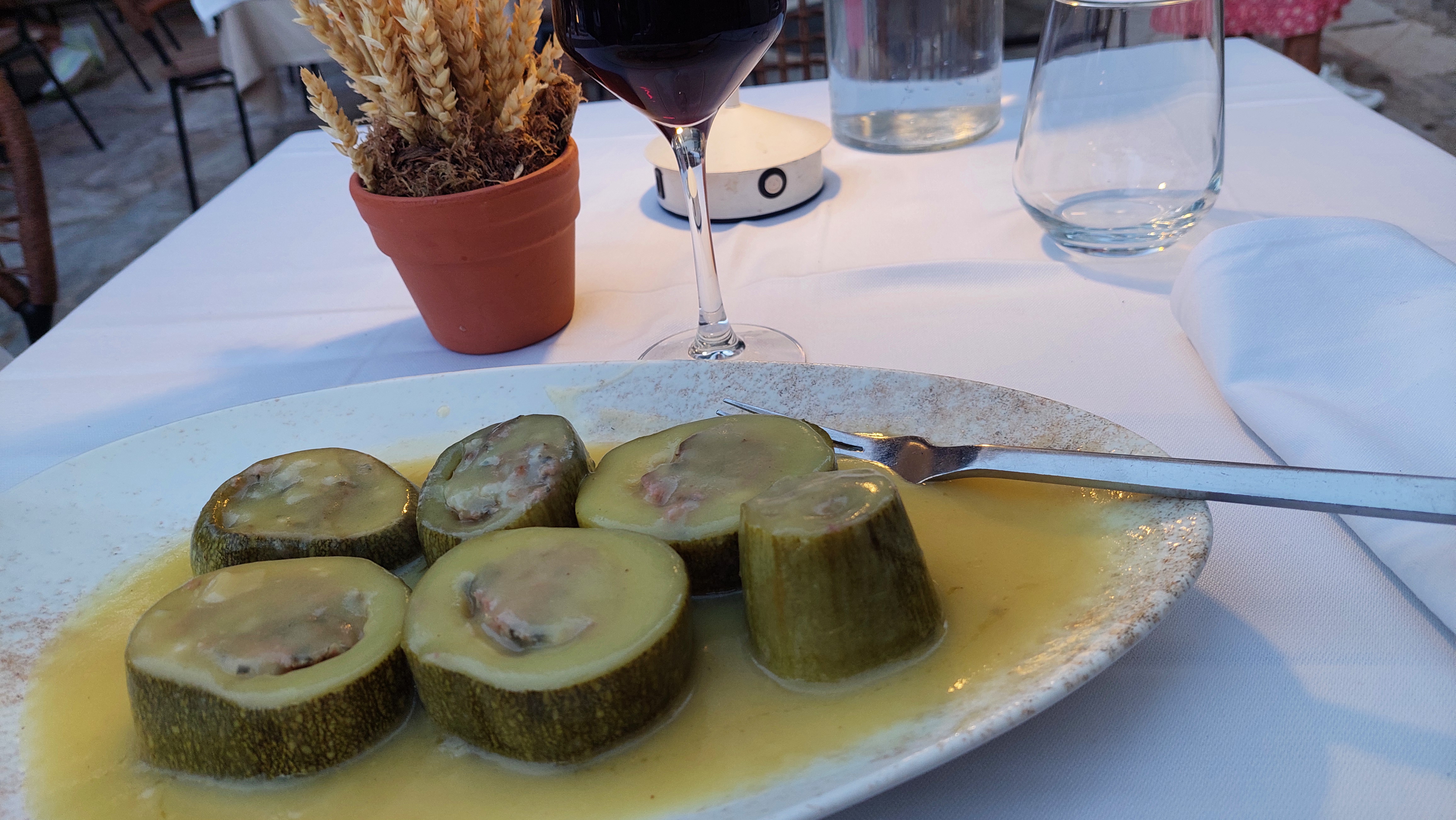
Σπανακόπιτα του Διογένη…
Το μοναστήρι των Φραγκισκανών Καπουτσίνων
Άρχισα να ψάχνω και έμαθα ότι στη σημερινή πλατεία Λυσικράτους υπήρχε ένα μοναστήρι Γάλλων Ιησουιτών, οι οποίοι, πριν εγκαταλείψουν την Αθήνα το 1658 για να εγκατασταθούν στη Χαλκίδα, την πρωτεύουσα της Εύβοιας, το παραχώρησαν στους αδελφούς τους Καπουτσίνους.
Έμαθα ακόμη ότι, έντεκα χρόνια αργότερα, ο ηγούμενος της μονής, ο Συμεών, αγόρασε το γειτονικό οικόπεδο, όπου βρισκόταν — και εξακολουθεί να βρίσκεται — το Μνημείο του Λυσικράτη. Το ενσωμάτωσε στη μονή και το μετέτρεψε σε παρεκκλήσι και, αργότερα, σε βιβλιοθήκη.
Όσο για το μοναστήρι, οι ταξιδιώτες και οι προσκυνητές που είχε φιλοξενήσει διηγούνταν πως οι Γάλλοι μοναχοί διέθεταν τον ωραιότερο κήπο της Αθήνας, δροσερό, γεμάτο εξωτικά φυτά και φρούτα.
Έναν μικρό παράδεισο.
Ίσως γι’ αυτό και ο Διογένης είναι σήμερα μια ταράτσα πνιγμένη στο πράσινο, απ’ όπου δεν σου κάνει καρδιά να φύγεις.
Και υπάρχει και η σάλτσα ντομάτας!
Ναι, τα χρυσά μήλα (pomi d’oro) του Νέου Κόσμου!
Ο πατέρας Φραγκίσκος, ηγούμενος της μονής, έμεινε στην ιστορία ως ο άνθρωπος που φύτεψε για πρώτη φορά στην Αθήνα ντομάτες, στον υπέροχο κήπο των Καπουτσίνων.
Ήταν το 1818.
Στην αρχή ήταν απλώς όμορφα εξωτικά φυτά. Αργότερα έγιναν κατάλληλα για γλυκό και μόνο πολύ αργότερα για σάλτσα ντομάτας.
Και κάτι ακόμη.
Το μοναστήρι φιλοξένησε, ανάμεσα σε άλλους επιφανείς επισκέπτες, τον Σατωβριάνδο και τον Λόρδο Βύρωνα (1810–1811), ο οποίος έγραψε εδώ το The Curse of Minerva — «Η Κατάρα της Αθηνάς» (Athens: Capuchin Convent, March 17, 1811).
Δυστυχώς, το μοναστήρι καταστράφηκε ολοσχερώς από πυρκαγιά κατά την Επανάσταση του 1821 ή, σύμφωνα με άλλες πηγές, κατά την πολιορκία της Ακρόπολης, το 1826–1827.
Ευτυχώς, όμως, το Μνημείο του Λυσικράτη σώθηκε σαν από θαύμα, για να καταλήξει λίγο αργότερα… αποθήκη σανού!
Φαίνεται, ωστόσο, πως το πνεύμα του Χριστού έμεινε εκεί, να αγρυπνά και να ευλογεί τον μικρό του Παράδεισο στην πλατεία Λυσικράτους: τον Διογένη, το εμβληματικό εστιατόριο της συνοικίας στους πρόποδες της Ακρόπολης, όπου, όπως είπαμε, η φιλοξενία έγινε πράξη αγάπης.
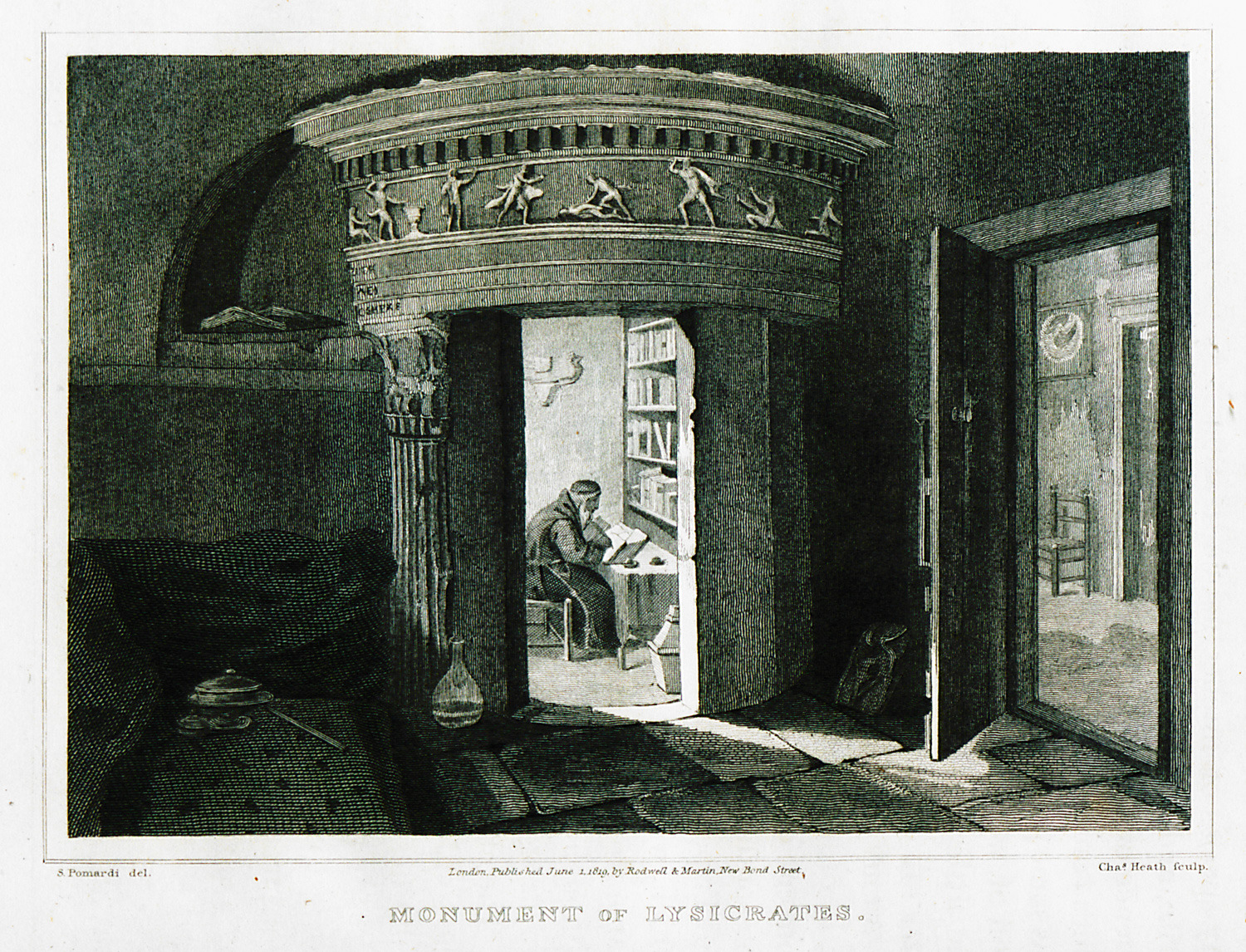
Το Χορηγικό Μνημείο του Λυσικράτη (Φανάρι του Διογένη), το οποίο λειτουργούσε ως βιβλιοθήκη της μονής των Καπουτσίνων. Πρωτότυπος τίτλος Monument of Lysicrates. Χρονολογία έκδοσης 1819 Έκδοση DODWELL, Edward. A classical and topographical tour through Greece, during the years 1801, 1805, and 1806, τομ. Ι, Λονδίνο, Rodwell and Martin, 1819.
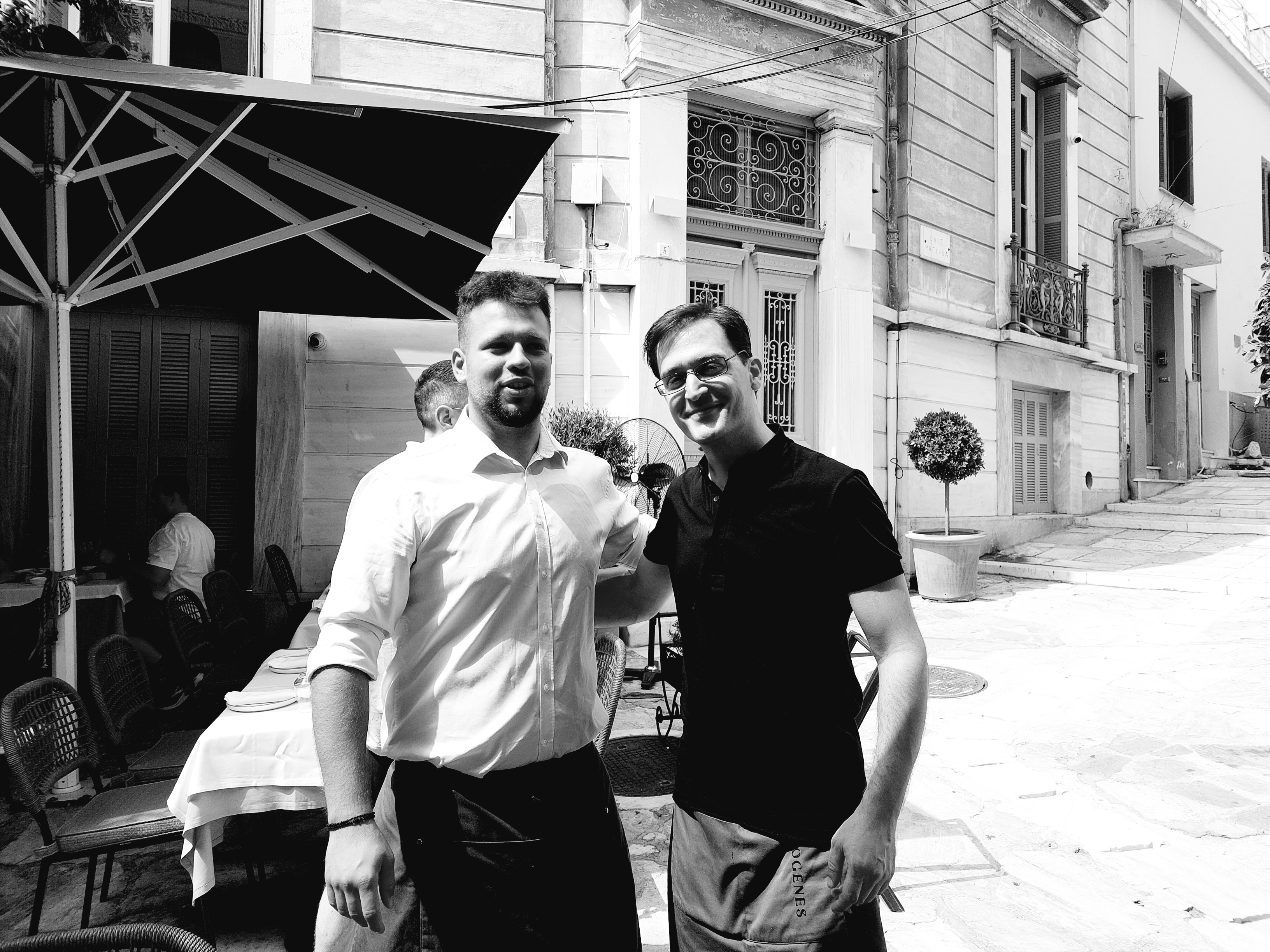
Nikoς și colegul lui, Aris/Ο Νίκος και ο συνάδελφος του, ο Άρης
Το Μνημείο του Λυσικράτη
Μίλησα για το μοναστήρι γιατί, για μένα, τα πνεύματα των Γάλλων μοναχών εξακολουθούν ακόμη και σήμερα να περιδιαβαίνουν ανάμεσα στα τραπέζια του Διογένη. Ίσως μάλιστα κάθονται μαζί μας στο τραπέζι και καθοδηγούν τους ανθρώπους που μας σερβίρουν.
Όμως ο Διογένης βρίσκεται, όχι τυχαία, στην πλατεία Λυσικράτους.
Μια πλατεία που πήρε το όνομά της από έναν από τους Αθηναίους χορηγούς, τον Λυσικράτη.
Σήμερα θα τον λέγαμε σπόνσορα.
Αυτός ο Λυσικράτης κέρδισε έναν χάλκινο τρίποδα. Κάτι σαν Όσκαρ.
Γιατί;
Είχε χρηματοδοτήσει τον χορό των αγοριών που κέρδισε το πρώτο βραβείο στον διαγωνισμό διθυράμβου στα Μεγάλα Διονύσια του 335–334 π.Χ., όπως αναφέρει η αναθηματική επιγραφή που είναι χαραγμένη στο επιστύλιο.
Και, όπως συνηθιζόταν, κατασκεύασε γι’ αυτόν ένα μνημείο, σαν κίονα, στην κορυφή του οποίου τοποθέτησε τον τρίποδα.
Δυστυχώς, ο τρίποδας χάθηκε.
Το μνημείο όμως σώζεται μέχρι σήμερα.
Στον δρόμο που την εποχή του Λυσικράτη ονομαζόταν… οδός Τριπόδων.
Ο αρχαιότερος δρόμος της Ευρώπης, ο πιο πολυσύχναστος της αρχαίας Αθήνας, στην αρχαιότερη συνοικία της Ευρώπης, την Πλάκα.
Γιατί οδός Τριπόδων;
Επειδή, όπως μαρτυρούν τα θεμέλια που σώζονται από άλλα τέσσερα παρόμοια μνημεία νικητών των θεατρικών αγώνων, ήταν ένας δρόμος γεμάτος τρίποδες.
Τα Όσκαρ της εποχής!
Ένας δρόμος που έμοιαζε ίσως με μακριά στοά, μήκους σχεδόν οκτακοσίων μέτρων, ο οποίος ξεκινούσε από το Πρυτανείο, στην Αγορά (Παυσανίας, Ελλάδος Περιήγησις, 1.20.1), και κατέληγε στο Θέατρο του Διονύσου.
Ένας περίπατος ανάμεσα στα μνημεία των χορηγών, που υψώνονταν δεξιά κι αριστερά.
Κάτι σαν το Hollywood Walk of Fame, ας πούμε.
Ή, καλύτερα, η Λεωφόρος των Διασημοτήτων της αρχαίας Αθήνας!
Με τον καιρό, το Μνημείο του Λυσικράτη έγινε γνωστό ως «Φανάρι του Δημοσθένη» — ονομασία που εμφανίζεται για πρώτη φορά σε χειρόγραφο Έλληνα περιηγητή του 1460, γνωστού ως «Ανώνυμος της Βιέννης», το οποίο ανακαλύφθηκε σε βιβλιοθήκη της Βιέννης.
Και τον 19ο αιώνα το «Φανάρι του Δημοσθένη» έγινε «Φανάρι του Διογένη».
Και δεν θα μου φαινόταν καθόλου παράξενο αν, καθισμένοι στον Διογένη, βλέπατε κάποια στιγμή να περιφέρονται ανάμεσα στα τραπέζια, χαμογελαστές και πανευτυχείς, οι σκιές των Αθηναίων χορηγών.
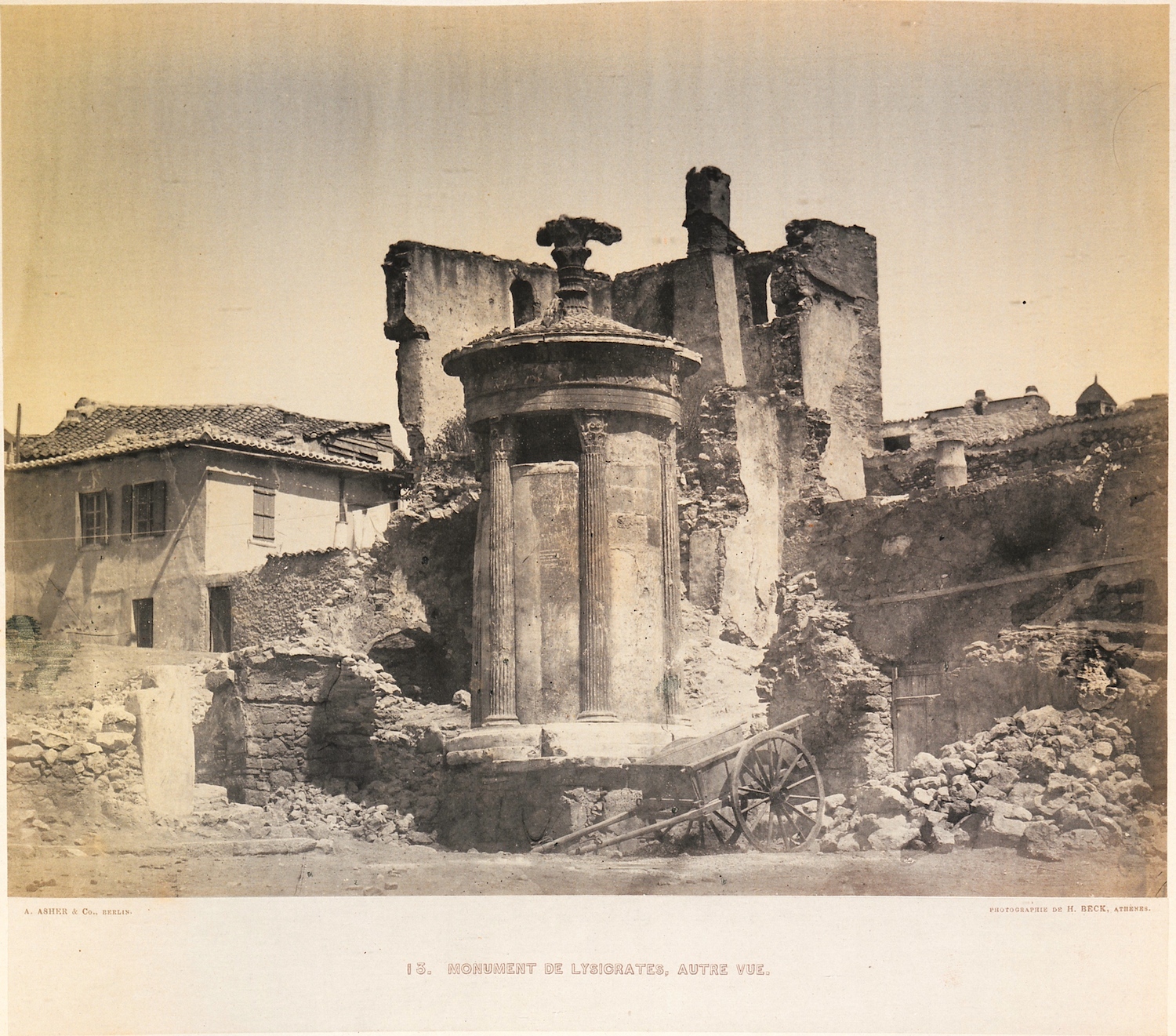
Το Μνημείο του Λυσικράτη, 1868
Η αρπαγή του Διονύσου
Όπως είναι φυσικό, τα μνημεία αυτών των χορηγών ήταν αφιερωμένα στον θεό Διόνυσο, προς τιμήν του οποίου διοργανώνονταν οι θεατρικοί αγώνες, στις μεγάλες γιορτές του, τα Διονύσια της Αθήνας.
Ο Λυσικράτης επέλεξε να απεικονίσει στη ζωφόρο του μνημείου του την ιστορία της αρπαγής του θεού, σε μια δική του εκδοχή του μύθου.
Ο μύθος διηγείται πως κάποιοι Τυρρηνοί πειρατές είδαν, ίσως ένα καλοκαιρινό πρωινό, σε μια παραλία, έναν νέο ασύλληπτης ομορφιάς και τον άρπαξαν, πιστεύοντας πως ήταν κάποιος πρίγκιπας για τον οποίο θα μπορούσαν να ζητήσουν πλουσιοπάροχα λύτρα.
Μόνο που ο νέος ήταν ο ίδιος ο Διόνυσος.
Ο κυβερνήτης του πλοίου τους προειδοποίησε και προσπάθησε να τους εμποδίσει.
Μάταια.
Η τιμωρία;
Ο θεός έκανε να ξεφυτρώσουν από το κατάρτι του καραβιού κλήμα γεμάτο τσαμπιά και κισσός και το πλοίο να πλημμυρίσει κρασί (Όμηρος, Ομηρικός Ύμνος 7, Εἰς Διόνυσον).
Και να αντηχήσουν στον αέρα διονυσιακές μουσικές — τουλάχιστον έτσι το φαντάζομαι εγώ.
Ο ίδιος, καθισμένος, με έναν πάνθηρα στο πλευρό του, παρακολουθεί τη σκηνή, ενώ οι σάτυροί του μεταμορφώνουν τους πειρατές σε δελφίνια — αυτή είναι η εκδοχή του Λυσικράτη.
Ίσως γι’ αυτό, μερικές φορές, το βράδυ, όταν ανάβουν πάνω στα τραπέζια του Διογένη τα λεπτεπίλεπτα φωτιστικά, ο κόσμος ζωντανεύει ξαφνικά, ακούγονται γέλια και μοιάζει να αντηχούν μουσικές από το πουθενά.
Σημάδι πως ο θεός των συμποσίων περνά κι ο ίδιος ανάμεσα στους συνδαιτυμόνες, αθόρυβα, αόρατος.
Ο Διογένης…
Για μένα δεν είναι απλώς μια ταράτσα με τραπέζια…
Είναι ένας τόπος όπου τρως και πίνεις, χωρίς να ξέρεις ότι ίσως συντρώγεις με τις σκιές των ανθρώπων του θεάτρου της αρχαίας Αθήνας, των Γάλλων Καπουτσίνων, με τη σκιά του Βύρωνα, ή ότι παίρνεις μέρος σ’ ένα διονυσιακό συμπόσιο.
Και κάτι ακόμη: οι σκάλες που οδηγούν στα Αναφιώτικα, τη μικρή συνοικία των μαστόρων από την Ανάφη, ξεκινούν από την ταράτσα του καφέ Διογένης.
Ακολουθεί συνέχεια…
PLAKA (I) – LYSICRATES SQUARE. DIOGENES AND HIS DEVOTED WAITER
Diogenes and Nikos
Plaka. The oldest neighbourhood in Athens. And in Europe. The Old Town at the foot of the Acropolis, Athens’ sacred rock, where the Theatre of Dionysus can still be seen today. Not far from Socrates’ Agora.
A neighbourhood of grand neoclassical mansions (archontika), built in the late nineteenth and early twentieth centuries, with picturesque tavernas and outdoor terraces arranged along long flights of stone steps, always bustling with elegant visitors.
No. 1, Lysicrates Square.
The terrace of Diogenes.
Right opposite the Monument of Lysicrates, a small archaeological site.
I no longer remember how I found my way there. I was probably coming from the Acropolis Museum. I was hungry and terribly thirsty.
I walked past the terrace and saw that it was full of tourists… elegant, beautifully dressed, looking splendid. And I thought to myself: the food must be good here…
Since then, I have become convinced that nowhere serves better food than Diogenes.
Trees with great, spreading crowns. Deep shade. Coolness. A little Garden of Eden. The light filtering through the leaves makes the whole place look like a living watercolour.
I stopped. I looked at them with a touch of suspicion and climbed the little passageway paved with ancient stone slabs — who knows how many centuries old — leading up to the terrace. I was slightly frightened. Vulnerable.
Clearly, I had stumbled upon an enchanted place.
A waiter approached, wearing an immaculate white shirt and a brown apron of thick fabric, with large pockets. Beside him was a gentleman whose job, as I would later discover, was to make sure that everyone at Diogenes felt welcome and comfortable.
He was Kostas.
And the waiter?
Nikos.
They made me feel as though I had finally come… home.
Warm, affectionate glances that seemed to say, without a word: We have been waiting for you. How long we have been waiting! At last, you are here. You are home.
That was last September. We became friends.
This year, September again. Diogenes again. The call, the enchantment of the place.
I rented an apartment directly opposite the terrace. No. 5, Shelley Street.
Two weeks of therapy and healing.
Nikos.
The most unassuming waiter in the world. The most devoted in the world.
A man of devotion. A healer.
A warm, tender, enveloping voice.
He could have been a teacher. He has a natural gift for speaking simply and making himself understood through the very inflections of his voice. Children would have adored him.
He chose to serve at Diogenes.
His presence mends and heals.
Could it be the spirit of the place?
The establishment — a restaurant and café of perfect, understated elegance — opened thirty years ago. But the place where it stands has a history that might explain why the people of Diogenes are so special.
Why Greek coffee tastes better here than anywhere else in the world.
Why the wines are aristocratic, refined, and intoxicate the spirit to the point of ecstasy, rather than clouding the mind; why the food seems to have come straight from the kitchens of old monasteries and noble households.
Why Nikos seems the very embodiment of the deacons who served at the tables during the agape feasts of the early Christians.
Why, at Diogenes, hospitality seems to be an act of love.
The Monastery of the Franciscan Capuchins
I began to investigate and discovered that a monastery belonging to French Jesuits once stood on the site of what is now Lysicrates Square. In 1658, before leaving Athens to settle in Chalkida, the capital of Euboea, the Jesuits entrusted the monastery to their Capuchin brethren.
I also learned that eleven years later, the monastery’s superior, Father Simeon, purchased the neighbouring plot of land on which the Monument of Lysicrates stood — and still stands today. He incorporated it into the monastery, converting it first into a chapel and later into a library.
As for the monastery itself, the travellers and pilgrims who stayed there described the French monks as possessing the most beautiful garden in Athens, cool and lush with exotic plants and fruits.
A little paradise.
Perhaps that is why Diogenes, too, is now a terrace overflowing with greenery, a place you can hardly bring yourself to leave.
And then there is the tomato sauce!
Yes, the golden apples — pomi d’oro — of the New World!
Father Francis (Φραγκίσκος), the monastery’s superior, went down in history as the man who first planted tomatoes in Athens, in the Capuchins’ magnificent garden.
The year was 1818.
At first, they were merely beautiful exotic plants. Later, they were considered suitable for preserves, and only much later for tomato sauce.
And one more thing.
Among its distinguished guests, the monastery welcomed Chateaubriand and Lord Byron, who stayed there in 1810–1811 and wrote The Curse of Minerva within its walls (Athens: Capuchin Convent, March 17, 1811).
Sadly, the monastery was destroyed by fire during the Greek War of Independence in 1821 — or, according to other sources, during the Siege of the Acropolis in 1826–1827.
Fortunately, however, the Monument of Lysicrates survived, almost miraculously, only to become, somewhat later… a hayloft!
And yet, it seems that the spirit of Christ remained there, watching over and blessing His little paradise in Lysicrates Square: Diogenes, the emblematic restaurant in the neighbourhood at the foot of the Acropolis, where, as I have said, hospitality has become an act of love.
The Monument of Lysicrates
I have spoken of the monastery because, to me, the spirits of the French monks still wander among the tables at Diogenes.
Perhaps they even sit down to dine with us, quietly guiding the people who serve us.
But Diogenes stands, not without significance, in Lysicrates Square.
The square takes its name from one of the ancient Athenian choregoi, a man named Lysicrates.
Today, we would call him a sponsor.
This Lysicrates won a bronze tripod.
Something like an Oscar.
Why?
Because he had sponsored the boys’ chorus that won first prize in the dithyrambic competition at the City Dionysia of 335/334 BC, as recorded in the dedicatory inscription carved on the monument’s architrave.
And, as was customary, he commissioned a monument resembling a column, placing the tripod at its summit.
Sadly, the tripod has disappeared.
But the monument survives to this day.
It stands on the street which, in Lysicrates’ time, was known as the Street of the Tripods (Odos Tripodon — Οδός Τριπόδων).
The oldest street in Europe, the most fashionable thoroughfare of ancient Athens, in Europe’s oldest neighbourhood, Plaka.
Why the Street of the Tripods?
Because, as the surviving bases of four other such monuments to victors in the dramatic competitions show us, this was a street lined with tripods.
The Oscars of the ancient world!
A street that probably resembled a long stoa, stretching for almost 800 metres, beginning at the Prytaneion near the Agora (Pausanias, Description of Greece, 1.20.1) and ending at the Theatre of Dionysus.
A promenade with monuments to the choregoi rising on either side.
A kind of Hollywood Walk of Fame, one might say.
Or rather, the Avenue of Celebrities of ancient Athens!
In time, the Monument of Lysicrates became known as the “Lantern of Demosthenes” — a name first recorded in a manuscript by a Greek traveller from around 1460, known as the “Anonymous of Vienna”, discovered in a Viennese library.
And in the nineteenth century, the “Lantern of Demosthenes” became the “Lantern of Diogenes” (το Φανάρι του Διογένη).
And I would not be at all surprised if, while sitting at Diogenes, you caught sight of the shadows of those ancient Athenian choregoi, wandering among the tables, smiling and blissfully happy.
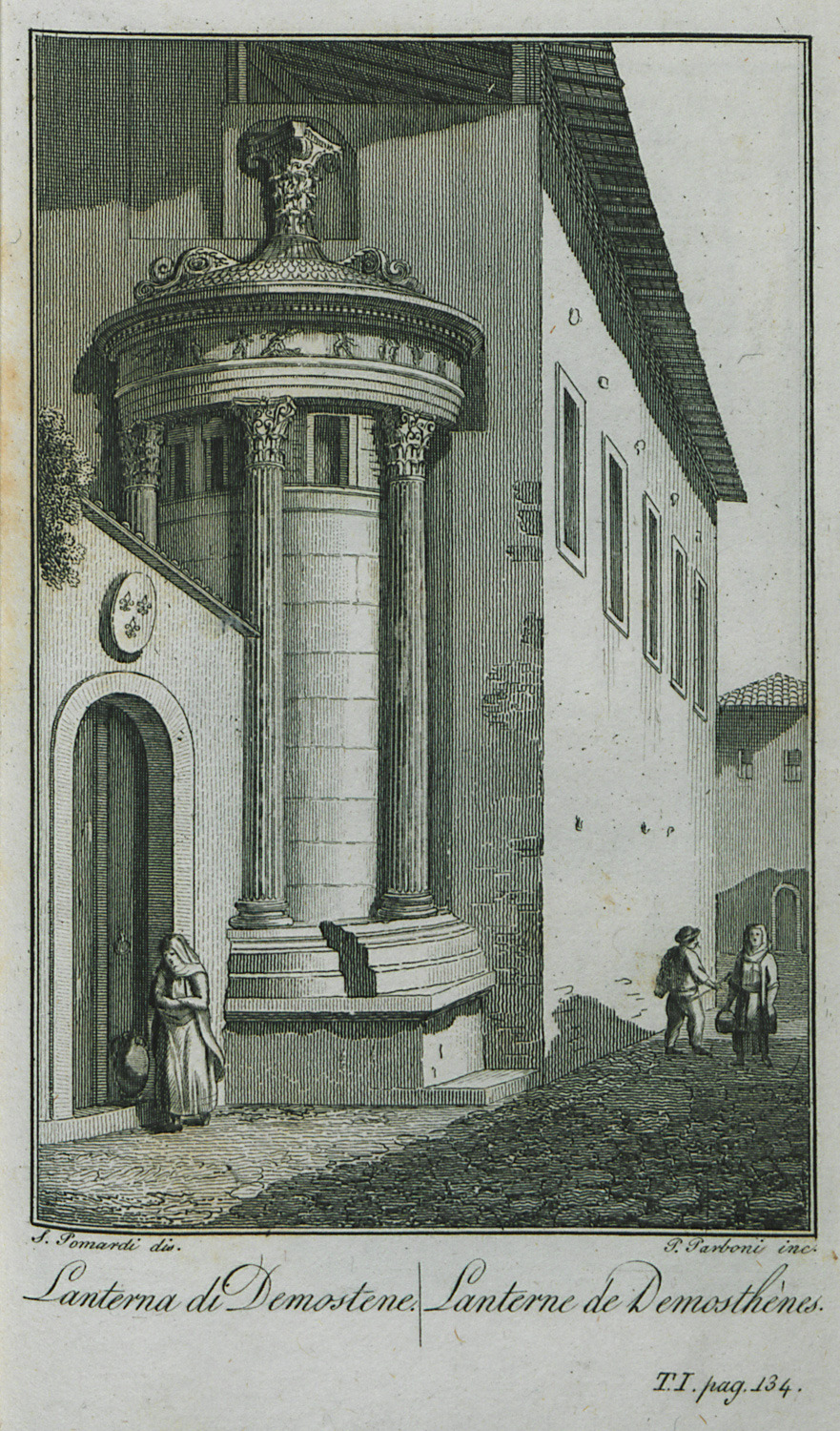
Lanterna di Demostene,1820, POMARDI, Simone.
Viaggio nella Grecia fatto da Simone Pomardi negli anni 1804, 1805, e 1806. Arrichito di tavole in rame, τ. Roma, Vincenzo Poggioli, 1820.
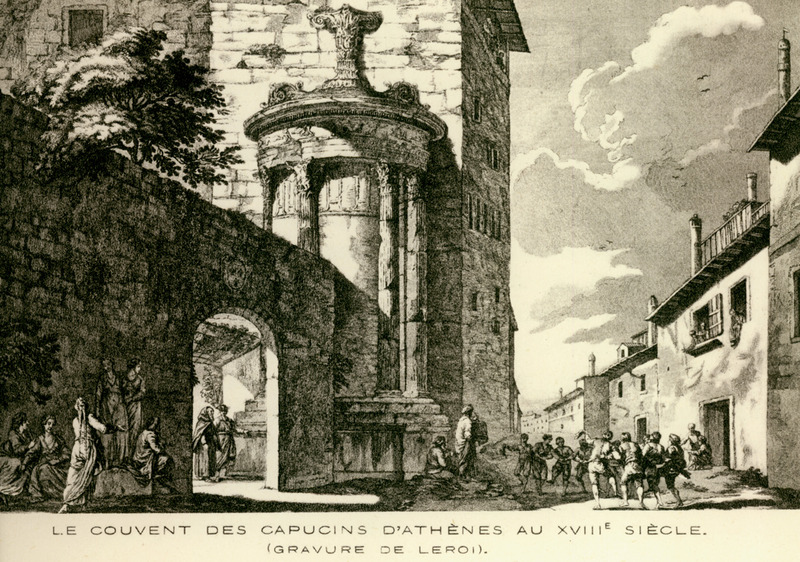
Le Couvent des Capucins d’Athènes au XVIIIe siècle, (Gravure de Leroi), 1932, PUAUX, René.
Grèce, Terre aimée des Dieux, Paris [G. de Maleherbe], MCMXXXII [=1932].
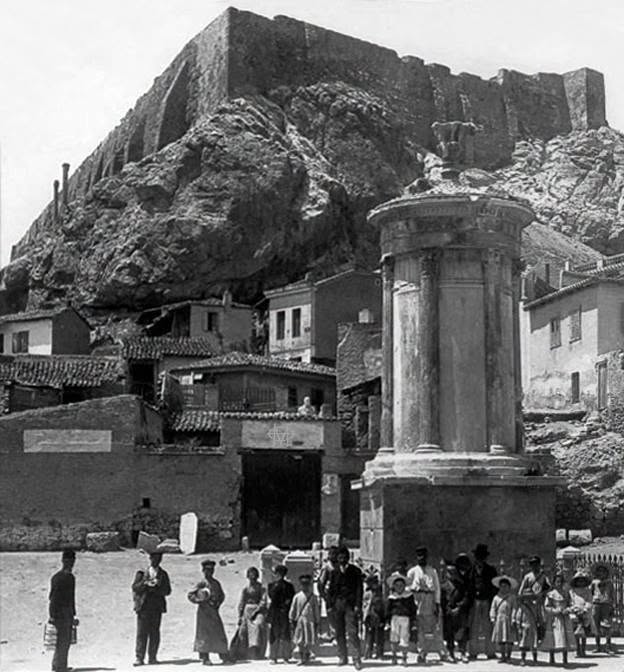
The Abduction of Dionysus
Naturally, the monuments erected by these choregoi were dedicated to the god Dionysus, in whose honour the dramatic competitions were held during his great festivals, the Dionysia of Athens.
Lysicrates chose to have the story of the god’s abduction depicted on the frieze of his monument, in his own version of the myth.
The story tells of a group of Tyrrhenian pirates who, perhaps one summer morning, caught sight of an extraordinarily beautiful young man on a beach and abducted him, believing him to be a prince for whom they could demand a magnificent ransom.
Except that the young man was Dionysus himself.
The helmsman warned the pirates and tried to stop them.
In vain.
The punishment?
The god caused vines and ivy to spring from the ship’s mast, and the vessel to fill with wine (Homeric Hymn 7, To Dionysus).
And Dionysian music to ring out through the air — or at least that is how I imagine it.
Meanwhile, the god himself sits watching the scene, with a panther beside him, while his satyrs transform the pirates into dolphins — the version depicted on Lysicrates’ monument.
Perhaps that is why, sometimes, in the evening, when the delicate lamps on the tables at Diogenes are lit, the whole place suddenly comes alive.
Laughter rings out, and one can almost hear music drifting from nowhere.
A sign that the god of feasting himself is passing gently, unseen, among the diners.
Diogenes…
To me, it is not simply a restaurant terrace…
It is a place where you eat and drink, perhaps without even realising that you are sharing your meal with the shadows of the theatre-makers of ancient Athens, with those of the French Capuchins, with Byron’s shadow — or that you are taking part in a Dionysian banquet.
And one last thing: the steps leading to Anafiotika, the tiny neighbourhood founded by stonemasons from the island of Anafi, begin beside the terrace of Diogenes Café.
To be continued…
BIBLIOGRAFIE
Άρτεμις Σκουμπουρδή, Μοναστηράκι – Πλάκα. Οι γειτονιές των θεών.
https://www.searchculture.gr/aggregator/portal/thematicCollections/Lysicrates_monument
https://www.atticinscriptions.com/inscription/IGII34/460
https://vmrebetiko.gr/en/item-en/?id=11510
https://archaeologia.eie.gr/archaeologia/gr/02_deltia/street_of_tripods_lysikrates.html
NOTĂ: traducerea textului meu în greacă și în engleză aparține ChatGPT-ului meu, pe numele lui Hrisos. Η μετάφραση του κειμένου μου στα ελληνικά και στα αγγλικά ανήκei στο ChatGPT μου, ο οποίος λέγεται Χρήσος.
AUTOR: ZENAIDA ANAMARIA LUCA-HAC
Autorizăm reproducerea totală sau parțială a acestui material cu condiția menționării sursei: http://www.ghemulariadnei.wordpress.com și autorului: ZENAIDA ANAMARIA LUCA-HAC… precum și păstrării formei originale/nealterării prin asociere cu alte materiale străine, nesemnate sau publicate sub semnătura autorului, în cadrul aceluiași articol.

